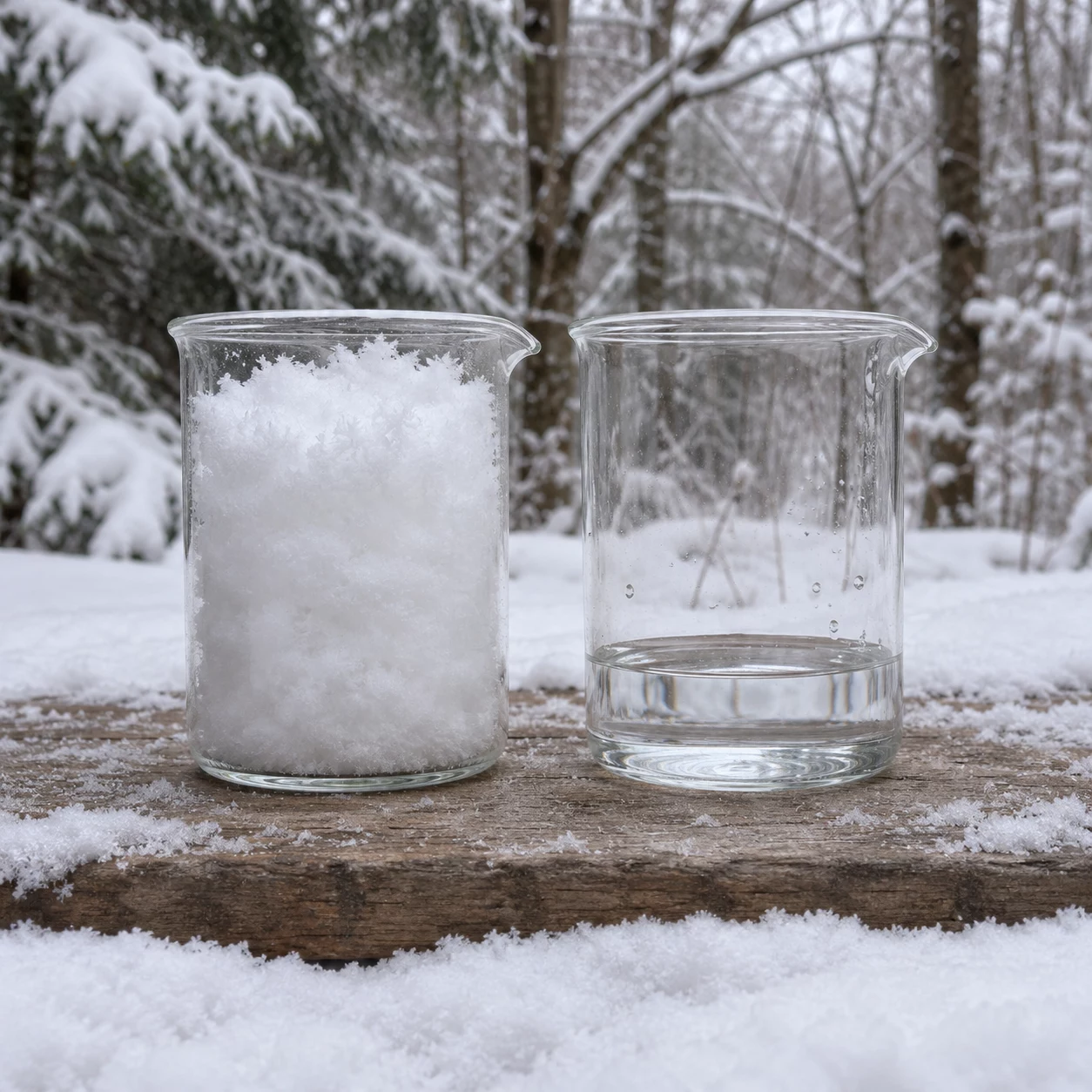
Ten centimetres of snow can melt into just a few millimetres of water, or considerably more. Snow depth tells you how much space it occupies. Its water equivalent tells you how deep the water would be if the whole sample melted over the same area.
What 10:1 means
Divide the depth of fresh snow by its liquid equivalent in the same units. At 10:1, 1 mm of water corresponds to 10 mm of snow, or 1 cm. If a forecast shows 8 mm of liquid equivalent and all of it falls as snow, a 5:1 ratio gives 4 cm, 10:1 gives 8 cm and 15:1 gives 12 cm. These are examples of the calculation. The ratio itself varies from storm to storm.
Why some snow takes up more space
Dry, branched flakes can trap a lot of air. Wet snow tends to pack into less space for the same amount of water. Conditions in the layers where snowflakes grow and fall also matter, so a thermometer at ground level tells only part of the story. Snow settles after landing, and wind can both pack it and move it. A drift by a wall may give a very different reading from an exposed spot a few metres away.
Reading a forecast or measuring at home
Check whether the map shows total precipitation, liquid equivalent of snowfall or snow accumulation. If some falls as rain, multiplying the total by a snow ratio overestimates snowfall. Snow may also melt on contact with mild ground. For a home comparison, measure fresh snow on a level board in a representative spot and sample the full depth. Melt it in a straight-sided container of the same diameter as the sampler so the two depths can be compared directly. Record the time and avoid drifts. Fresh snowfall and total snow depth are separate measurements.