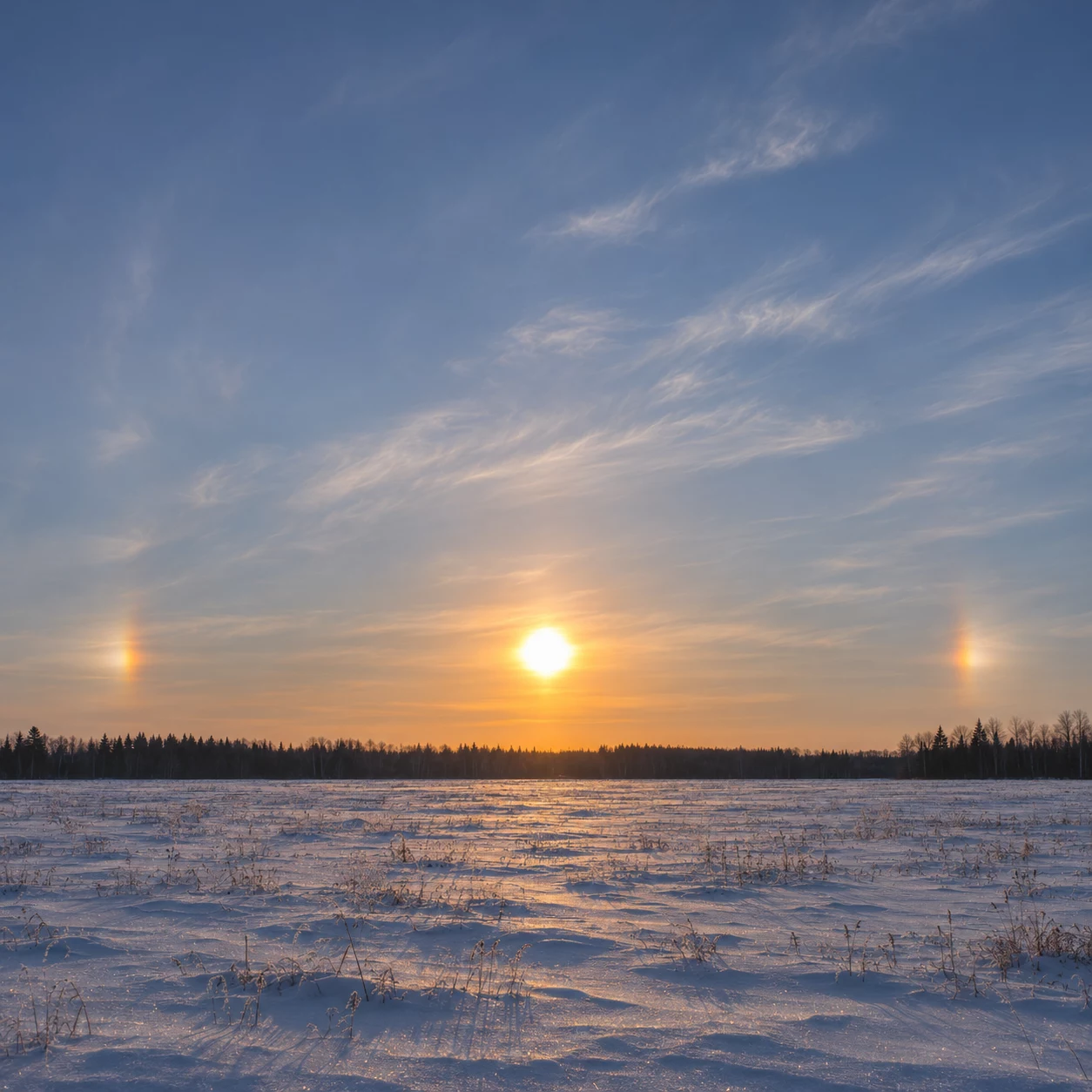
On a winter afternoon, you might notice a bright patch to the left of the Sun and a similar one to the right. These are sun dogs, also called parhelia. They can occur in any season, and sometimes only one is visible because the ice crystals are unevenly distributed.
How sun dogs form
Thin high clouds such as cirrus can contain flat, six-sided ice crystals. When many of these plates lie nearly horizontal, sunlight passing through their sides bends and separates into colours. With the Sun low, the patches appear about 22° to either side, at the same height. They can sit farther away when the Sun is higher.
Three clues to look for
Look for a bright patch level with the Sun, with a reddish edge towards it and paler colours farther out. A 22° halo makes a ring around the Sun and can appear at the same time. An ordinary rainbow forms in water droplets and appears opposite the Sun.
How to observe them
Hide the solar disc behind a building and scan the sky on either side without looking directly at the Sun. If you take a photo, include the cloud and horizon for context. Sun dogs reveal ice high in the atmosphere. On their own, they cannot tell you whether it will rain tomorrow.