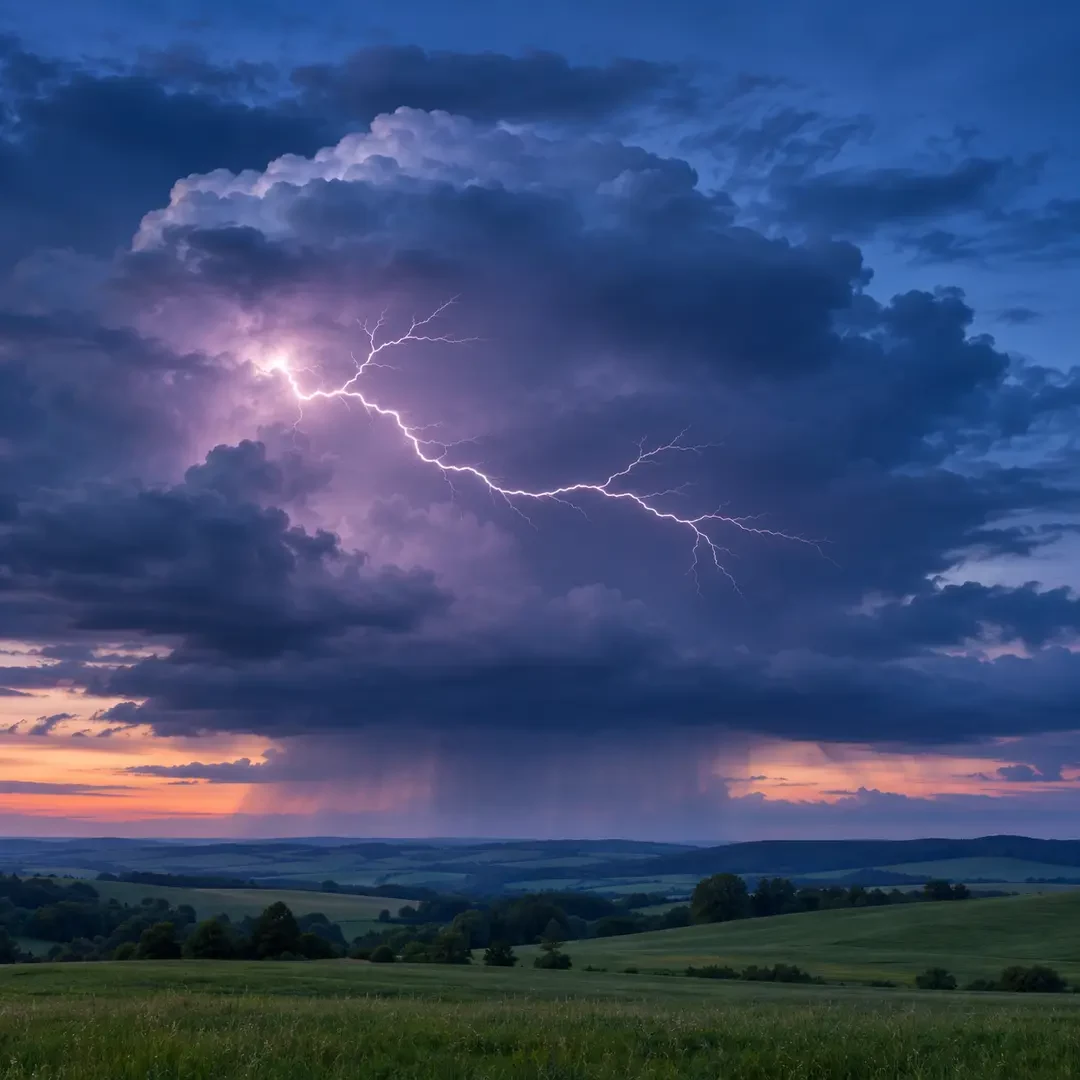
A lightning flash may last only a fraction of a second, yet its thunder can seem to roll across the sky for much longer. Sometimes it arrives as a hard, dry crack; at other times it is a low rumble that rises and fades. These are not separate phenomena. They are different ways of hearing sound produced along a long, irregular lightning channel.
Thunder begins with extremely rapid heating
In a fraction of a second, the electrical discharge heats the air around its channel to temperatures of tens of thousands of degrees. The air expands explosively, compressing the surrounding air and creating a shock wave. As that disturbance travels and weakens, it becomes the sound wave we recognise as thunder.
Thunder is therefore not the sound of clouds colliding or of something falling from the sky. It is the atmosphere responding to the sudden heating caused by lightning.
A lightning flash is a line, not a point
The rumble is mainly a question of geometry. A lightning channel can run for several kilometres, branch repeatedly and occupy parts of the cloud at very different distances from the listener. Every small section produces its own shock wave. Sound from the nearest section arrives first; waves from increasingly distant sections follow.
This spread in arrival times turns an almost instantaneous discharge into an audible sequence. NOAA describes thunder as the combined effect of many shock waves created along the lightning path. Our ears do not identify them individually: we hear bangs, changes in loudness and a continuous roll.
Nearby crack, distant rumble
When the channel is relatively close, the wavefront remains abrupt and may sound like a snap, crack or short explosive bang. Farther away, the waves become stretched, weaker and more separated in time. The result is a lower, longer rumble.
Distance also removes high-frequency components more readily than low ones. A distant thunderclap therefore loses much of its sharp edge while the deeper frequencies remain audible.
Why one thunderclap changes volume
A roll of thunder does not always fade smoothly. Some channel sections may be aligned so that several waves reach the observer at nearly the same time and reinforce one another. Others arrive farther apart. Buildings, hills and valleys can reflect sound, while temperature and wind variations refract it and bend its path.
That is why one flash may produce an initial bang, a brief lull and a second series of rumbles. It also explains why two listeners a few kilometres apart may describe the same flash differently.
Can the sound reveal the distance?
Only roughly. A violent crack usually suggests that part of the channel is nearby, while a muted roll usually indicates a more distant flash. Channel geometry and atmospheric conditions, however, make tone alone an unreliable measuring tool.
A simple estimate uses the delay between the flash and the first sound: about three seconds per kilometre. Our guide to estimating thunderstorm distance from lightning and thunder explains the calculation and its limits. It must never be used to postpone seeking shelter.
The safety message matters more than the acoustics
If you can hear thunder, electrical activity is close enough to be dangerous. Do not wait for a loud crack or for rain to reach you. Move into a substantial building or a fully enclosed metal-topped vehicle, and remain sheltered for 30 minutes after the last thunder.
- Quiet thunder does not mean zero risk.
- Lightning can occur away from the main rain shaft.
- Counting seconds is an estimate, not permission to stay outdoors.
In short
Thunder rumbles because lightning creates shock waves along an extended channel. Nearby parts are heard before distant ones; distance softens the higher frequencies; and channel geometry, terrain and the thermal structure of the atmosphere alter propagation. The result ranges from a brief crack to a roll that seems to cross the whole sky. Whatever its sound, thunder is a warning to get to safety.