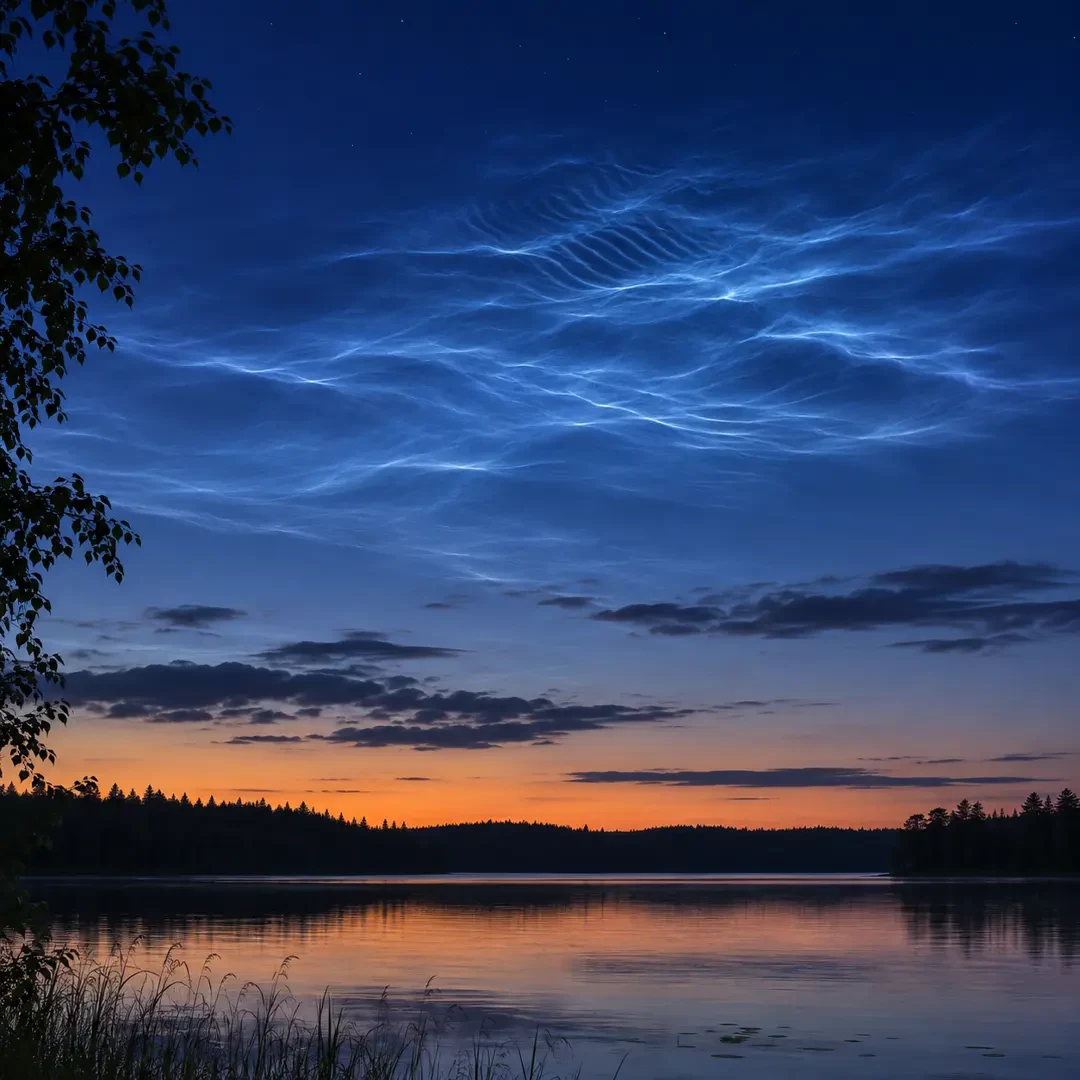
Some clouds seem to remain lit after the landscape below has turned dark. Noctilucent clouds display delicate blue or silver filaments and rippled veils. They do not generate their own light: they reflect sunlight from an exceptionally high part of the atmosphere.
Far above familiar weather clouds
The World Meteorological Organization places them in the mesosphere, roughly 80–85 km above the ground. Tiny ice crystals form on dust particles. These are not the low clouds that might bring rain to tomorrow’s walk, nor a direct indication of precipitation at the surface.
Sunset happens at different heights
After sunset, the ground and lower atmosphere enter shadow while these very high clouds can still receive sunlight. Their pale threads stand out against a darker background. Twilight therefore matters as much as the clouds themselves: a bright sky may hide the contrast.
Why summer matters
Surprisingly, the mesosphere reaches its lowest temperatures in summer, allowing ice to form at those heights. Conditions in your garden cannot be transferred directly to the atmosphere tens of kilometres above it. In Europe, viewing is mainly associated with summer nights at middle and high latitudes. This is not a forecast of sightings for November.
Watching and identifying
Find an unobstructed view towards the twilight sector, usually north during the northern summer. Ordinary lower clouds may appear dark in front of the higher bright layer. Ripples and a silvery colour are useful clues, but a blue-looking photograph alone is not confirmation. Record time, location and viewing direction; a sequence is more informative than one frame.
Sightings are not guaranteed across Europe and are uncommon farther south. Do not confuse these clouds with auroras. This guide describes a phenomenon rather than an ongoing event, and its cover is a generated illustration.