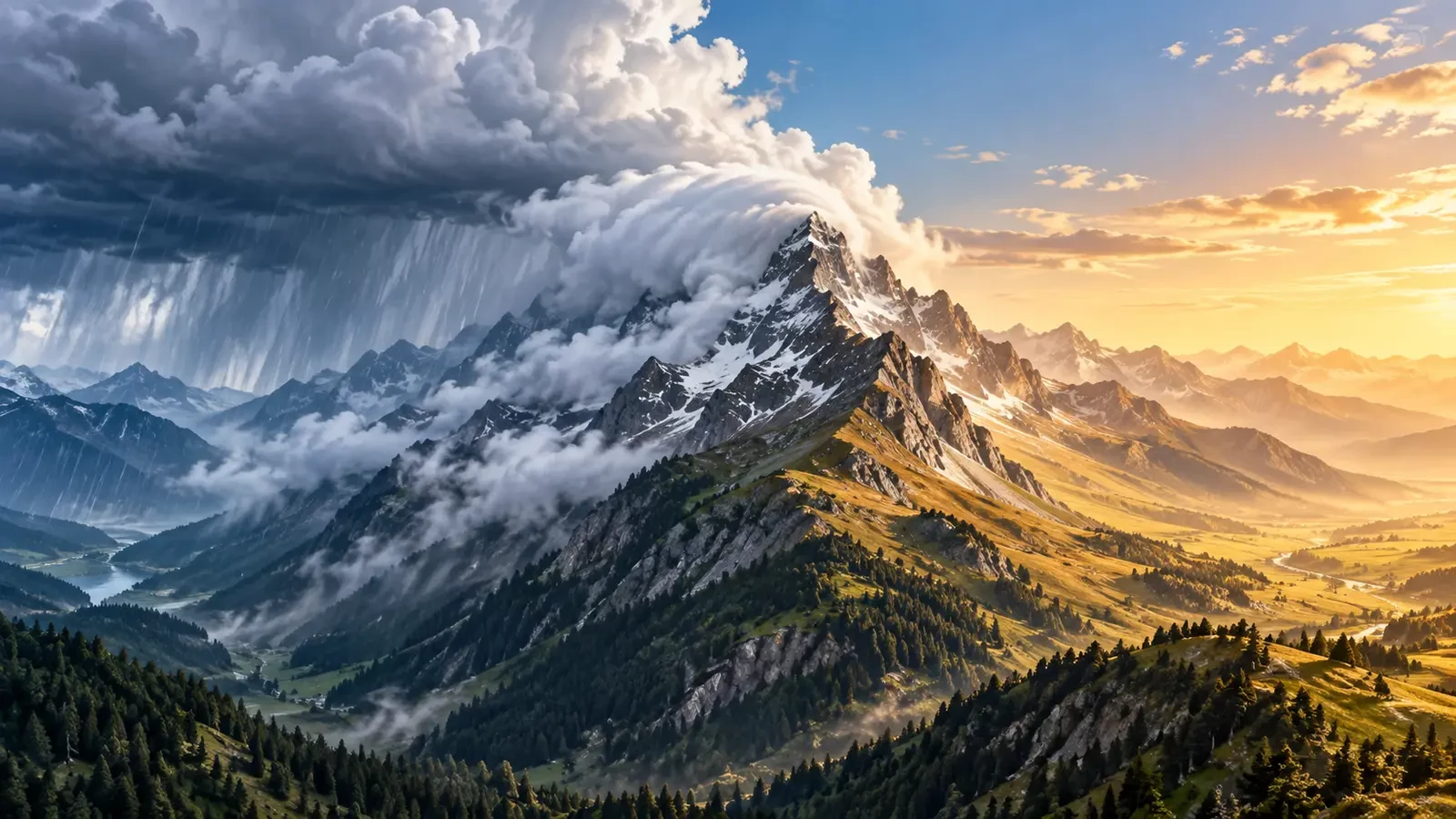
Two valleys separated by one mountain range can experience very different weather: cool rain on one side, but clearer skies, stronger wind and a sharp temperature rise on the other. This contrast is typical of the foehn effect, in which air becomes warmer and drier as it descends on the leeward side of high ground.
Windward and leeward sides
When cross-mountain wind meets a ridge, some air is forced uphill on the windward slope. Pressure decreases with height, so the rising air expands and cools. If it reaches saturation, cloud forms and rain or snow may fall. Beyond the crest, descending air encounters higher pressure, is compressed and warms.
If moisture has been removed by precipitation, or if the descending flow originates in drier air aloft, relative humidity falls quickly. A warm, bright and gusty valley may therefore sit close to a cloud-covered windward slope.
Rain is not essential
The textbook explanation emphasises condensation and precipitation upstream, but dry foehn events also occur. Air can be drawn down from higher levels; turbulence behind the ridge can mix warmer, drier air towards the surface; and clearing skies can allow additional solar warming. Several mechanisms often operate together.
Clues to look for
- A cloud bank held against the crest or windward slope.
- Clearer skies and unusually good visibility to leeward.
- A marked fall in relative humidity.
- A rapid temperature rise, sometimes overnight.
- Strong, irregular gusts and turbulence in valleys.
- Lenticular or rotor clouds near the range.
No single clue proves a foehn. Meteorologists consider wind through a depth of the atmosphere, humidity, pressure and cloud structure together.
Why it can be hazardous
Foehn is more than a warm wind. Gusts and rotors can affect hiking, cable cars, work at height and aviation. Dry, fast-moving air can remove moisture from vegetation and help an existing wildfire spread. In snow-covered mountains, sudden warming can accelerate melt and alter snowpack stability, so local avalanche bulletins remain essential.
Is it a heatwave?
Not necessarily. Foehn is a local response to airflow across terrain and may last from hours to days. A heatwave is a prolonged spell of unusually high temperatures for a region and season. Foehn can produce exceptional warmth in one valley while nearby areas remain cool.
Reading a forecast
Check wind direction relative to the ridge, compare temperature and humidity on both sides, and note warnings for wind, fire weather or avalanches. Conditions in a sheltered valley cannot be safely projected onto the crest, where wind, cloud and visibility may change abruptly.
The useful lesson is that mountains do not merely block weather; they transform it. Moist ascent and dry descent can create strikingly different conditions only a few kilometres apart.