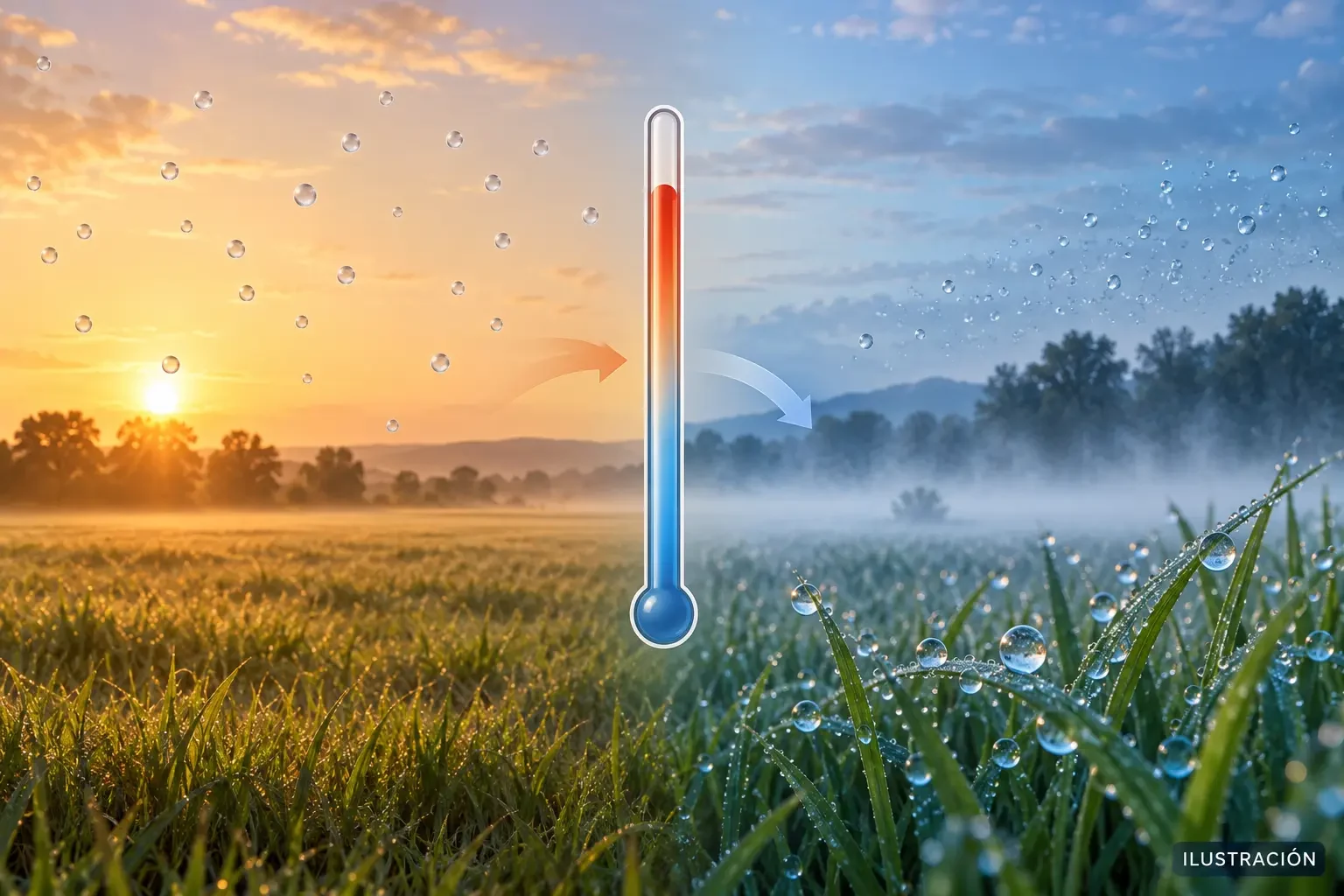
A forecast may show 90% humidity around dawn and only 45% in the afternoon even when the air mass has not changed dramatically. The apparent contradiction disappears once we separate two ideas: relative humidity and dew point. Both concern water vapour, but they answer different questions.
This is an educational guide. It does not replace current weather warnings or public-health advice.
What relative humidity means
Relative humidity states, as a percentage, how close the air is to saturation at its current temperature. A value of 100% means saturation with respect to liquid water; it does not mean the air is entirely water, nor does it guarantee rain.
The equilibrium amount of water vapour changes strongly with temperature. If a parcel of air cools without gaining or losing much vapour, its relative humidity rises. If it warms, relative humidity falls. This is why percentages are often highest overnight and in the early morning, then lower during the warm part of the day.
What dew point is
Dew point is the temperature to which air would need to cool, approximately at constant pressure and without changing its water-vapour content, to become saturated. When air temperature equals dew point, relative humidity is 100%.
Because it relates more directly to the actual amount of vapour, dew point is often more useful than relative humidity for comparing the moisture of two air masses. A higher dew point indicates more water vapour; a lower one indicates drier air.
The temperature–dew point gap
Forecasters also watch the separation between air temperature and dew point. A wide gap suggests air well short of saturation. A narrowing gap means saturation is approaching. This is useful when assessing condensation potential, but it cannot predict fog, cloud or rain on its own.
Dew forms when a surface cools to the dew point of the air immediately beside it. Fog also needs suitable conditions through a layer of air: enough cooling, moisture and compatible wind mixing. Rain requires droplets or ice crystals to form and grow inside clouds. Therefore, high relative humidity does not automatically mean rain.
An everyday example
Imagine a mild afternoon with moderate relative humidity. After sunset, the ground and nearby air cool. Even if the amount of vapour changes little, relative humidity rises. If a surface reaches the dew point, droplets may form on grass or glass. After sunrise, temperature rises and relative humidity may fall quickly even though the vapour content changes only slightly.
How to use both figures in a forecast
- To compare air masses: examine dew point together with air temperature.
- To judge closeness to saturation: compare temperature and dew point, or check relative humidity.
- To assess muggy heat: high temperature combined with abundant moisture makes sweat evaporate less efficiently. Also consult heat indices and official warnings.
- To anticipate overnight condensation: consider forecast minimum temperature, dew point, cloud cover and wind. One number is never a guarantee.
- For driving: when temperature and dew point converge in light winds, check the visibility forecast and our guide to driving safely in fog.
Common mistakes
- Comparing two humidity percentages without considering their temperatures.
- Reading 100% humidity as certain rainfall.
- Confusing dew point with the forecast minimum temperature: they may come close, but they are different variables.
- Treating an indoor, sunlit or wall-mounted sensor as representative of outdoor air.
- Ignoring how wind, cloud, terrain and proximity to the sea affect local conditions.
Humidity and heat: an important precaution
In hot weather, high humidity reduces the effectiveness of sweating and can increase heat strain. No single humidity value determines risk by itself: temperature, sunshine, wind, exertion, exposure time, clothing and health all matter. Follow official alerts and see our guide to staying safe in extreme heat.
In summary
Relative humidity expresses closeness to saturation at the current temperature. Dew point gives the saturation temperature and a more direct reference for the vapour present. Reading both alongside temperature, wind and cloud cover prevents misleading conclusions.