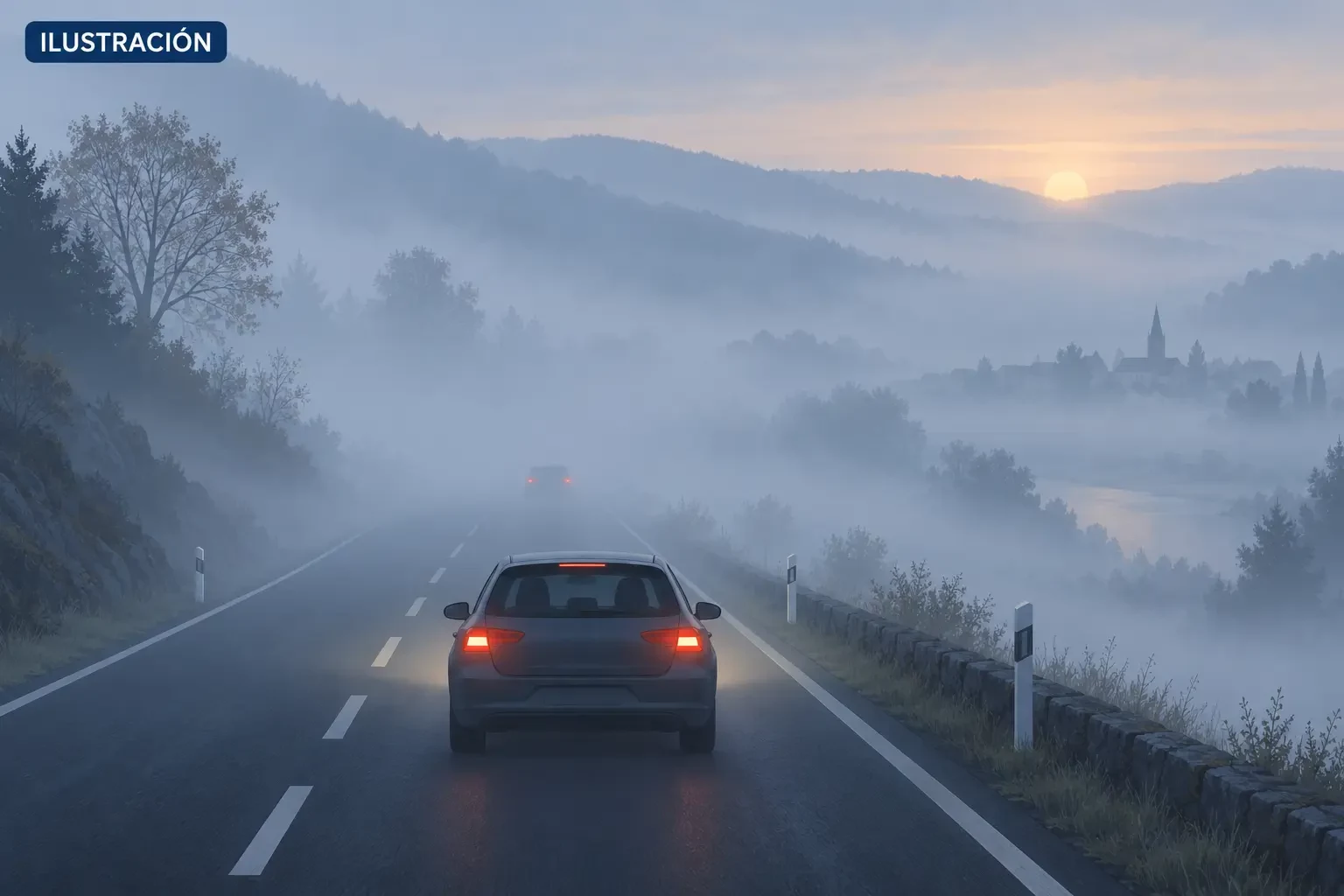
Fog can turn a familiar road into a difficult environment within seconds. It does more than shorten how far you can see: it hides bends, stopped vehicles, pedestrians and changes in gradient, while moisture may leave the road wet. The safe response is not to maintain your usual pace, but to adapt every part of your driving to the distance you can actually see.
This is general guidance, not a current warning. Before travelling, check warnings from the national weather service and official traffic information for each country on your route.
What fog is and why it can be patchy
Meteorologically, fog consists of tiny water droplets suspended near the ground that reduce horizontal visibility. It can form when air close to the surface cools to saturation, especially on clear nights with light winds, or when moist air moves over a colder surface. Valleys, rivers, hollows and coastal areas can favour local fog banks.
Its uneven nature is especially hazardous: acceptable visibility can give way to dense fog over a very short distance. A clear start to a journey does not guarantee a clear route.
The essential rule: stop within the distance you can see
Your speed must let you stop within the visible, clear stretch of road. If you can only make out a few roadside posts or markings ahead, your reaction margin is equally short. Slow down progressively before entering fog, check your mirrors and avoid sudden braking that may surprise traffic behind.
Leave substantially more space behind the vehicle ahead. Its rear lights may provide orientation, but do not follow closely just to keep them in sight: you may copy a mistake or have no room if it stops suddenly. Use road markings to remain in your lane and avoid overtaking when you cannot verify that the whole manoeuvre is safe.
Which lights to use
- Dipped headlights: help you see and, crucially, make the vehicle visible from the front and rear.
- Front fog lights: may improve low and lateral illumination where fitted and where local rules permit their use.
- Rear fog light: reserve it for seriously reduced visibility under local law. It is very bright and may dazzle other drivers; switch it off when visibility improves.
- Full beam: do not use it. Light scatters back from the droplets and can create a bright veil that makes it harder to see.
Do not rely entirely on automatic lights: in diffuse daylight some systems may not switch on every lamp you need. Check the controls manually.
Windscreen, moisture and road surface
Use the wipers when fine droplets settle on the glass, and ventilation or demisting to keep the inside clear. Fog often leaves the road damp, so allow more braking space and make smooth steering, acceleration and braking inputs. At temperatures close to or below 0 °C, freezing fog can deposit ice on the road and vehicle.
When visibility is no longer sufficient
Do not stop in a live lane or on a narrow hard shoulder except in an emergency. Without sudden manoeuvres, look for an exit, service area or place fully separated from moving traffic. If a breakdown forces you to stop, follow the country's emergency rules, warn other road users and move occupants away from the impact zone when it is safe.
Quick checklist
- Check the forecast, weather warnings and official road conditions.
- Inspect lights, wipers, screenwash and tyres.
- Slow before entering fog and increase following distance.
- Use dipped headlights; avoid full beam and switch fog lights off when no longer needed.
- Delay or interrupt the journey if you cannot maintain a safe margin.