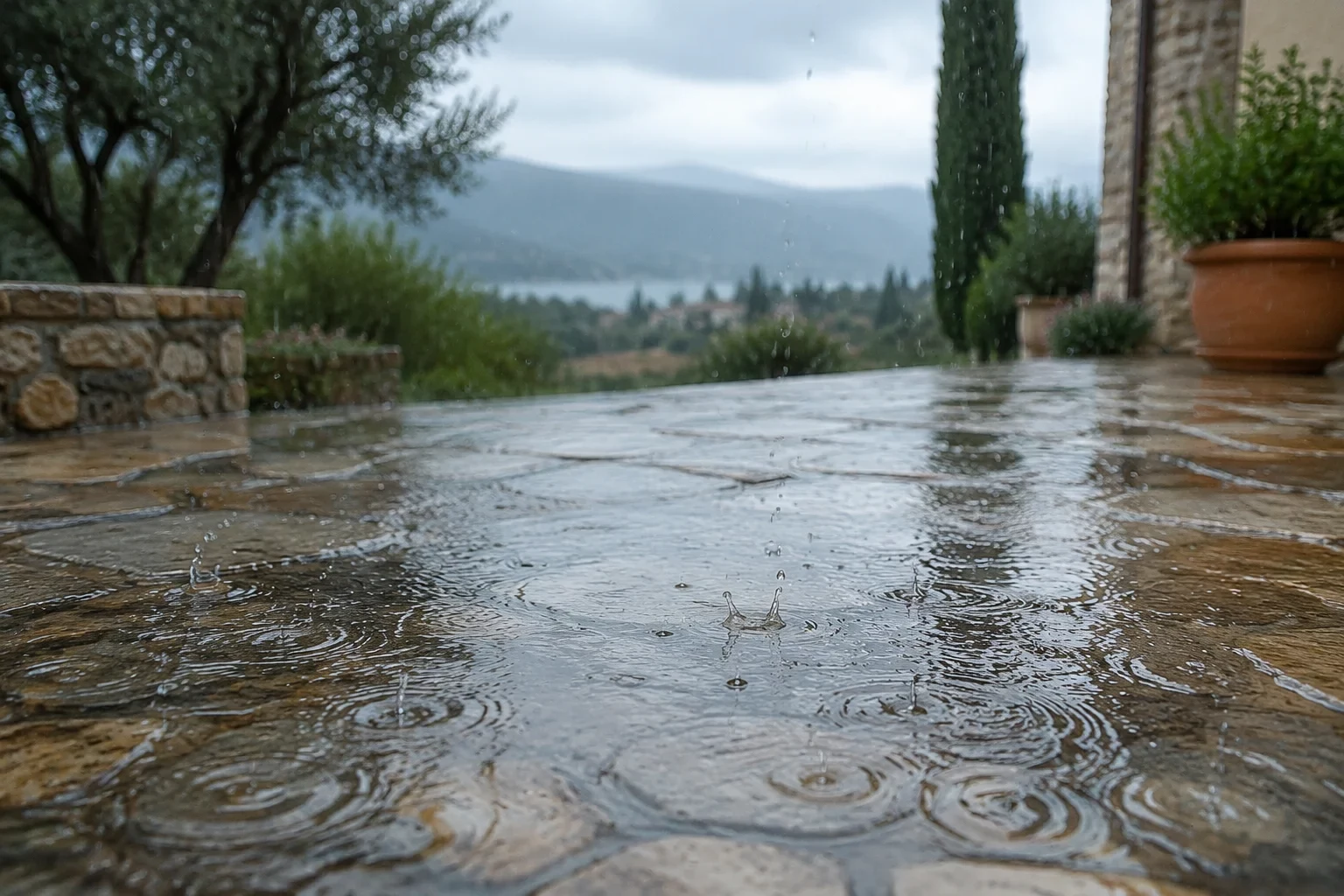
One millimetre of rain equals one litre of water per square metre. The figure describes an amount, but you also need to know the collection period. Ten millimetres over a day and ten millimetres in ten minutes give the same total with very different timing.
Why millimetres?
Imagine a level area of one square metre where water neither drains away nor evaporates or soaks in. A layer one millimetre deep has a volume of 0.001 cubic metres: one litre. Thus 5 mm equals 5 l/m² and 20 mm equals 20 l/m². This does not mean a real puddle will have that depth.
Amount is not intensity
Accumulation is given in mm over a period; intensity is commonly given in mm/h. In a hypothetical example, 12 mm over six hours averages 2 mm/h. The same 12 mm in fifteen minutes averages 48 mm/h during that quarter-hour. It does not mean 48 mm will fall: that would require the rate to continue for a full hour.
Reading an app correctly
- Check whether the figure is mm, mm/h or a probability percentage.
- Find the start and end of the period: one hour, six hours or a whole day.
- Distinguish forecasts from observed measurements and check the update time.
- Check the location: one station does not represent an entire district equally.
AEMET provides hourly observations and daily totals. Read each product’s description before comparing numbers.
A patio calculation
If 8 mm falls uniformly on a horizontal area of 15 m², the volume falling on it is 8 × 15 = 120 litres. This is an ideal calculation, not the volume you can collect or the water left on the ground. Losses and drainage change the real result.
How many millimetres is a lot?
There is no useful answer without duration and context. A daily total does not reveal whether rain was concentrated into minutes. Do not convert an isolated figure into a warning level: for an event in Spain, check your area’s official warning, its validity and the named hazard.
Two common mistakes
A 70% probability does not mean 70 mm. A forecast of 0 mm is not an absolute guarantee of no rain: it remains a forecast. For planning, consider amount, period and updates together.