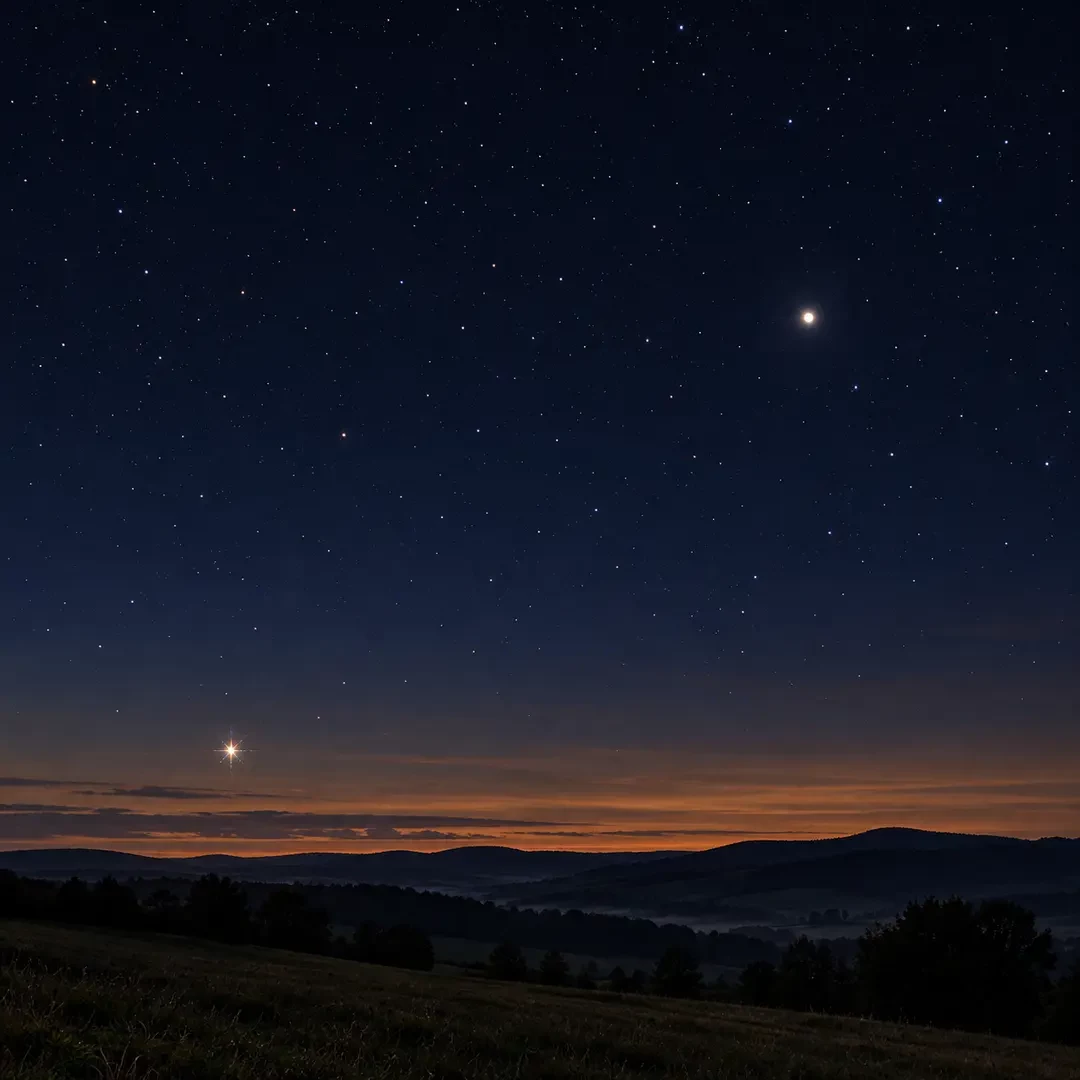
On a clear night, a bright star may change intensity rapidly and even flash red, blue or green for an instant. A nearby planet often appears steadier. The star is not switching its light on and off: the effect is produced while its light crosses Earth’s atmosphere.
The atmosphere is not a uniform lens
Air contains layers and small cells with different temperatures and densities. Each refracts, or bends, light by a slightly different amount. As these structures move and evolve, the apparent position and brightness of a star change many times each second. Our eyes combine those shifts into twinkling.
This is related to what astronomers call seeing: the sharpness and stability allowed by the atmosphere. A cloudless night can still have poor seeing when the air is turbulent, while stable air is little help if cloud, fog or haze blocks the view.
Why a star twinkles more than a planet
Stars are so distant that they behave like point sources to the naked eye. A small atmospheric deflection can affect much of that point. Planets, although they may look point-like without magnification, have a larger apparent disc. Their light reaches us along many neighbouring paths, so the disturbances partly average out and the brightness looks steadier.
This is not absolute. A planet close to the horizon or seen through very unstable air can scintillate too. Twinkling is therefore a useful clue, not a complete identification method.
Why low stars flicker more and change colour
Near the horizon, light travels through much more atmosphere than when an object is high in the sky. It encounters more temperature and density variations, as well as moisture and aerosols. Refraction also separates colours slightly, so a bright star may produce rapid coloured flashes. The effect generally weakens as the same object rises.
Seeing, transparency and cloud are different
- Cloud cover determines whether the sky is open.
- Transparency describes how much moisture, haze, dust or pollution dims the light.
- Seeing describes how strongly turbulence blurs and shakes an image.
Faint-star observing benefits from good transparency; fine detail on the Moon and planets relies heavily on stable seeing. Check cloud, visibility, humidity, wind and approaching fronts before heading out, but remember that no single surface measurement guarantees good conditions.
Simple ways to improve the view
Choose a dark, safe site with a clear horizon. Avoid looking directly over roofs, asphalt or walls releasing stored daytime heat, because local convection degrades the image. Observe planets when they are higher, allow your eyes to adapt to darkness and dim your phone screen.
With binoculars or a telescope, use a firm surface and let the instrument approach outdoor temperature. Do not mistake a flashing low star for an aircraft: aircraft show appreciable motion and regular navigation-light patterns.
A visible sign of a dynamic atmosphere
Twinkling turns the atmosphere into a shifting lens. It cannot diagnose the weather or predict a storm by itself, but it does reveal that the air between you and the object is not optically uniform. Comparing a low star, a high star and a bright planet is a simple way to see the difference.