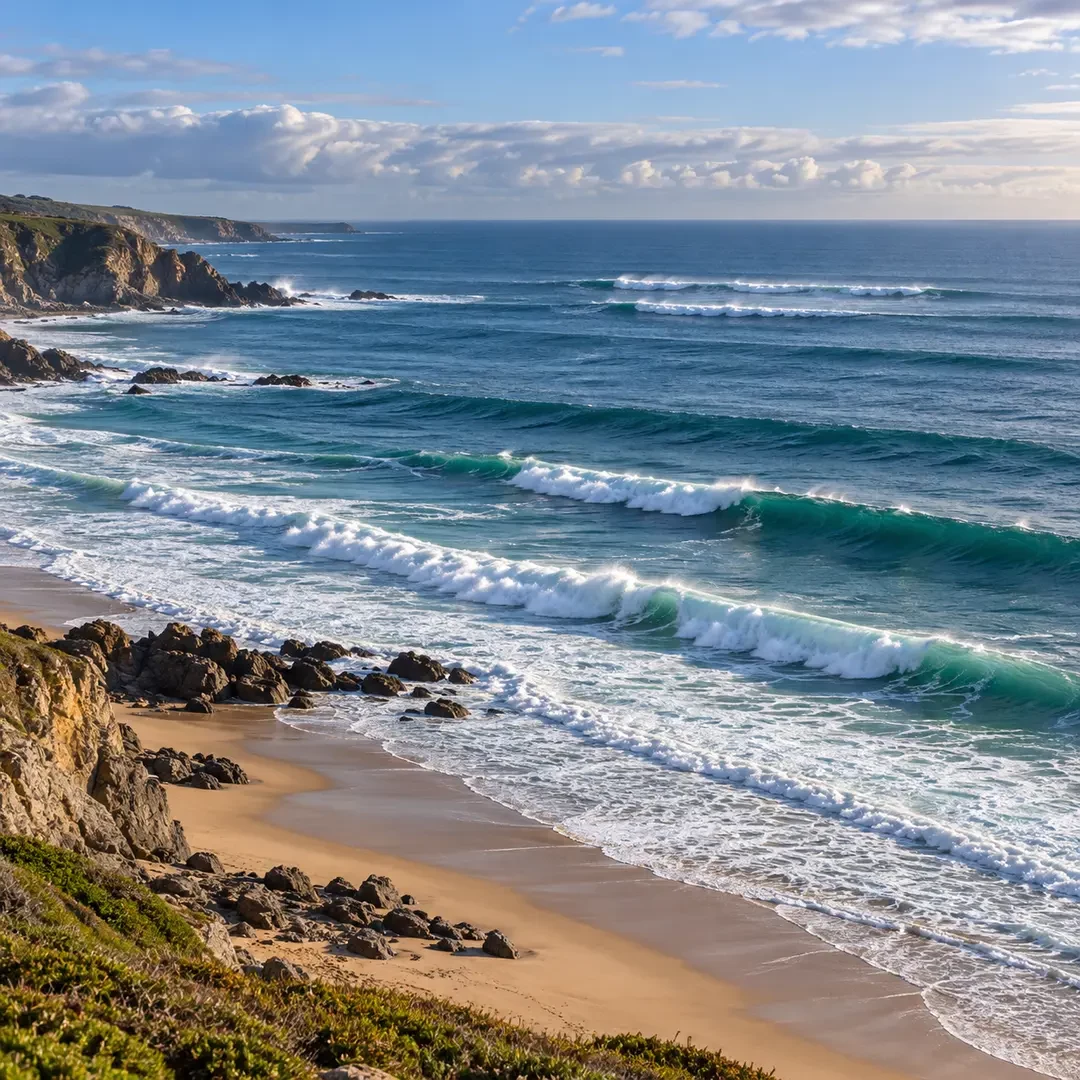
From shore, the sea rarely keeps a steady rhythm. Several larger waves may arrive together, followed by a deceptively quiet spell. This is not a scheduled pause, and it does not support the popular claim that every seventh wave is the biggest. It results from waves of different periods, heights and directions combining.
Waves carry energy rather than water across the ocean
Wind transfers energy to the sea surface. The waves that develop depend partly on wind speed, how long it blows and the distance of open water over which it acts, known as fetch. Once generated, swell can travel away from its storm and reach a coast where local winds are light.
In deep water, water particles mainly move in orbital paths while energy travels onward. A crest approaching the beach is therefore not made of the same water that left a distant storm.
How wave groups appear
A real sea contains many waves at once. When crests line up, their effects add and create a cluster of larger waves. When a crest meets a trough, they partly cancel and the surface looks calmer. This interference creates a visible envelope: a set of higher waves separated from the next by a less active interval.
The group and each individual wave are different features and need not travel at the same speed. Several swell systems may also cross one another. There is therefore no fixed number of waves in a set and no universal clock for the next large breaker.
Three forecast details worth checking
- Period: the time between successive crests at one point. Long-period swell is usually more organised and can break more powerfully or run farther up the beach than short-period waves of the same height.
- Significant wave height: roughly the average of the highest third of waves, not a maximum. Individual waves can be higher.
- Direction: this controls which beaches face the swell and which are partly sheltered by headlands or islands.
As waves enter shallow water, they slow, shorten and steepen until they break. Seabed shape, sandbars, reefs and shoreline orientation may focus or disperse energy, so neighbouring stretches of coast can behave differently.
Why a lull is not an all-clear
A quiet gap can tempt people onto wet rocks, harbour walls or newly exposed sand. The next set may wash farther inland, knock someone down or block the route back. Larger breaking groups can also feed pulses in rip currents as accumulated water finds deeper channels back offshore.
Watch for several minutes from a dry, elevated position before approaching. Check the marine forecast, wave period, tides and local warnings; obey closures and stay back from wet edges. Use lifeguarded beaches where available and follow local instructions. Never turn your back on the sea for a photograph.
Observe the pattern, but do not treat it as a promise
You can choose a fixed point, time successive crests and note how many prominent waves arrive together. That is useful for recognising a pattern, but it does not make the sea predictable. Wind, tides, currents and overlapping swell trains can change the sequence quickly.
The practical lesson is simple: waves arrive in sets because many waves alternately reinforce and weaken one another. The quiet interval is part of the same process, not evidence that the sea has stopped sending energy toward shore.