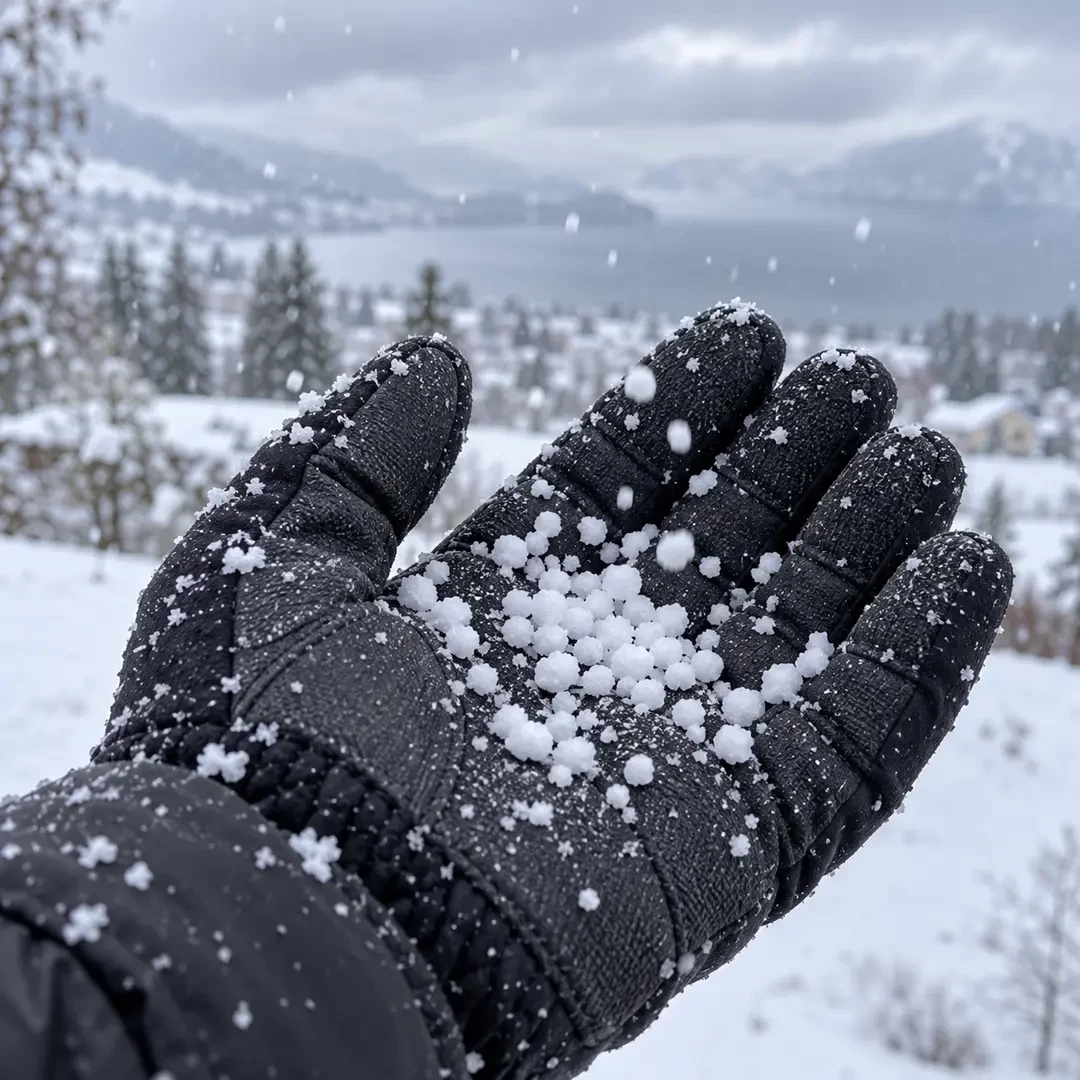
A cold shower can scatter small white balls across the ground. They bounce, look rather like hail and may briefly whiten a road, yet they are often graupel, also known as snow pellets. Identifying them gives useful clues about the cloud, the air mass and the actual hazard at ground level.
What is graupel?
Graupel begins as a snow crystal or snowflake. As it falls through a cloud, it meets supercooled water droplets: liquid droplets that remain unfrozen below 0 °C. They freeze rapidly onto the crystal in a process called riming. Once enough droplets have accumulated, the original crystal shape is hidden inside a rounded or conical, white, opaque pellet.
The World Meteorological Organization’s International Cloud Atlas describes snow pellets as generally 2–5 millimetres across. Air spaces make them relatively light, brittle and easy to crush. They may bounce when they land on a hard surface, but they often break apart. Snow pellets commonly fall in short showers from cumulus or cumulonimbus clouds, sometimes mixed with snowflakes, when surface temperatures are near freezing.
How is graupel different from hail?
The most useful distinction is not size alone but structure. Graupel is matt white, light and crumbly. Hail is denser ice: it may be clear, translucent or opaque, makes a sharper sound on impact and will not collapse under gentle pressure. The WMO generally uses about 5 millimetres as the lower size boundary for hail, although appearance and hardness matter when particles are close to that threshold.
Hail grows in the strong updraughts of cumulonimbus clouds. An embryo remains aloft, collects water and may build alternating layers of ice before it becomes too heavy. Hail—especially large hail—is therefore associated with convective thunderstorms and can damage crops, vehicles and roofs. A brief graupel shower does not by itself indicate severe weather, although pellets can quickly make roads and paths slippery.
Not snow and not ice pellets
- Snow: retains branching crystals or clusters of crystals. Flakes are soft rather than compact little balls.
- Graupel or snow pellets: forms when supercooled droplets rime a snow crystal. It is white, opaque, light and easily crushed.
- Ice pellets: usually form when falling snow melts partly or fully and then refreezes before reaching the ground. They are harder and more translucent.
- Hail: grows by collecting water and ice inside a thunderstorm and is harder and usually larger.
A practical check
Observe from shelter. If the particles are small, foam-white, crush easily through a glove and fragment on impact, graupel is likely. If they are solid, noisy and sometimes translucent, they are more likely to be hail or ice pellets. After the shower has passed, a photograph beside a ruler can document the size without exposing you to lightning or falling hail.
What to do when it settles
Soft pellets can still reduce grip on roads, pavements and slopes. Slow down, increase following distance and avoid sharp braking or steering. In the mountains, graupel may also create a weak layer beneath later snowfall; route and avalanche decisions must rely on the official local avalanche bulletin rather than the appearance of one shower.
Use several clues together: fragile white pellets in a cold shower point to graupel, while hard ice in a thunderstorm points to hail. The label matters less than responding to the conditions that the precipitation creates.