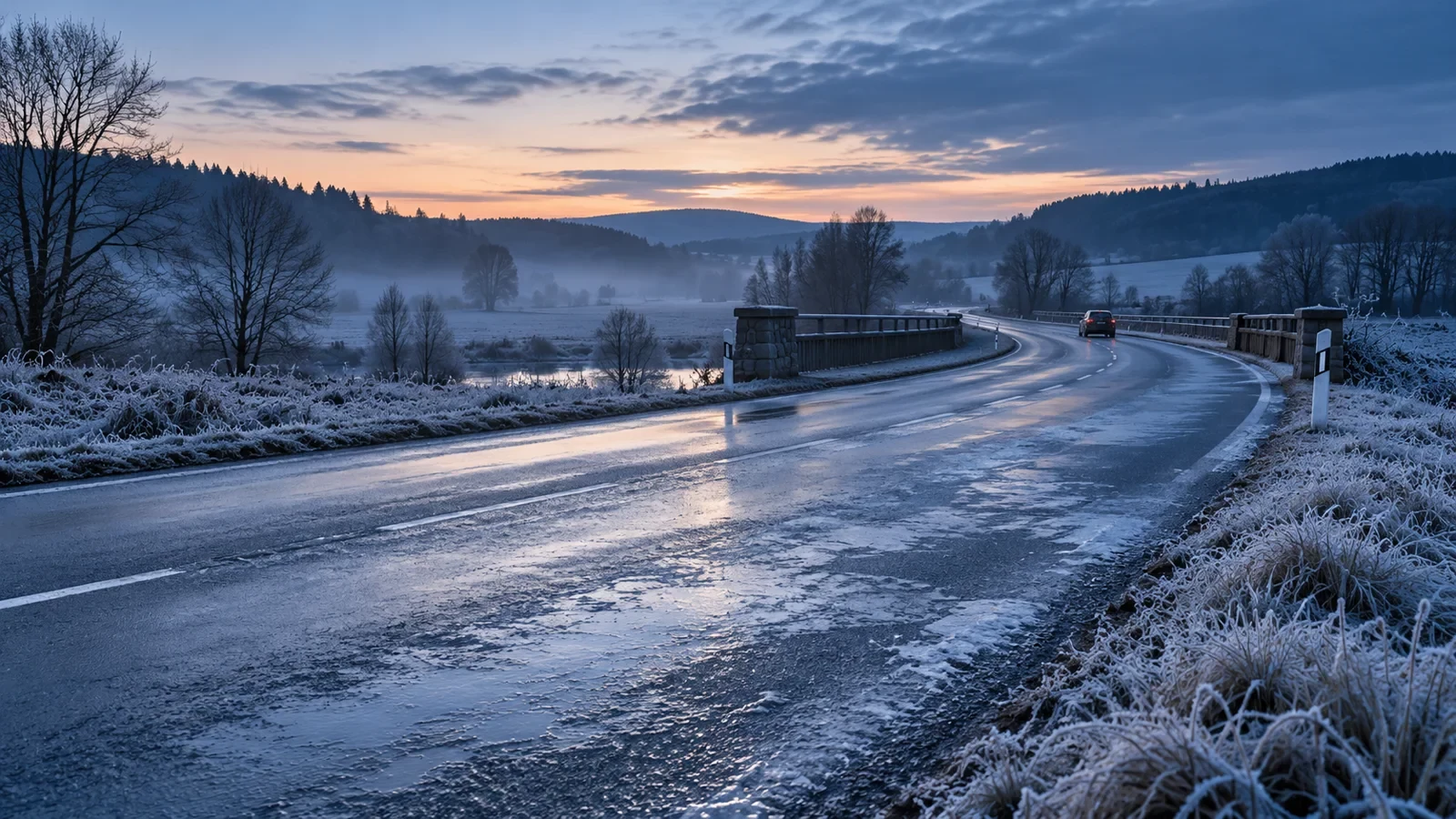
A road may look merely damp while offering very little grip. Black ice is a thin, transparent layer through which the dark road surface remains visible. It can be difficult to identify from a moving vehicle, and grip may change within a few metres. The safest approach is to recognise the conditions that favour ice and preserve a generous safety margin.
What black ice is
It can form when liquid water freezes on the road, or when moisture settles and freezes. Rain, fog, melting snow or condensation followed by cooling may all contribute. The surface need not look white: transparent ice often resembles a wet or slightly glossy patch.
Road treatment lowers the risk but cannot guarantee uniform grip. The official Highway Code guidance for adverse weather warns that even treated roads may remain icy and that stopping distances on ice can be up to ten times greater than on dry roads.
Places and times that deserve extra caution
- Bridges and overpasses, which lose heat from both above and below.
- Bends, hollows and shaded stretches that warm slowly.
- Wet roads after rain, thaw or fog, especially overnight and around dawn.
- Changes in altitude or exposure, where safe and icy sections may alternate quickly.
The car's temperature display is only a guide. A particular patch of road can be colder than the air measured by the vehicle.
Warning signs
Look for frost on verges, vegetation, barriers or the windscreen; an uneven sheen on the road; reduced spray; and a sudden change in tyre noise. Steering that feels unexpectedly light or tyres that become almost silent can suggest a loss of grip. No single sign proves ice is present, and the absence of these clues does not make the road safe.
Before the journey
- Check the forecast, official warnings such as AEMET's alerts, and current road information.
- Delay a non-essential trip when widespread ice is expected.
- Fully clear windows, mirrors and lights.
- Check tyre condition and pressure, wipers and suitable screenwash or coolant.
- On long or isolated routes, carry warm clothing, a charged phone and basic emergency supplies.
How to drive when ice is possible
Slow down before a suspicious stretch and greatly increase the gap ahead. Accelerate, steer and brake gently; complete most braking before a bend. Use a gear that lets the car progress without suddenly delivering torque to the wheels. Avoid overtaking, rapid lane changes and manoeuvres that demand an abrupt correction.
Suitable tyres and electronic aids help, but they cannot create grip. Four-wheel drive does not shorten braking distance on a slippery surface.
If the vehicle begins to slide
Stay calm, look where you want to go and avoid stamping on the brake or accelerator. Ease off the accelerator and make small, smooth steering corrections. The right response depends on the kind of skid, vehicle layout, ABS and stability control, so a universal instruction such as “always steer into the skid” can be misleading. Allow the safety systems to work and follow the vehicle handbook. Once grip returns, reduce speed gradually; if conditions are unmanageable, stop somewhere safe.
Common mistakes
- Assuming a treated road or another vehicle's tracks are safe.
- Braking hard in a bend after entering too quickly.
- Following closely because traffic is moving slowly.
- Believing winter tyres, four-wheel drive or electronics remove the danger.
A useful rule
When moisture combines with temperatures near freezing, behave as though ice could be present: less speed, more distance and gentler inputs. Anticipation is far more effective than an emergency manoeuvre.