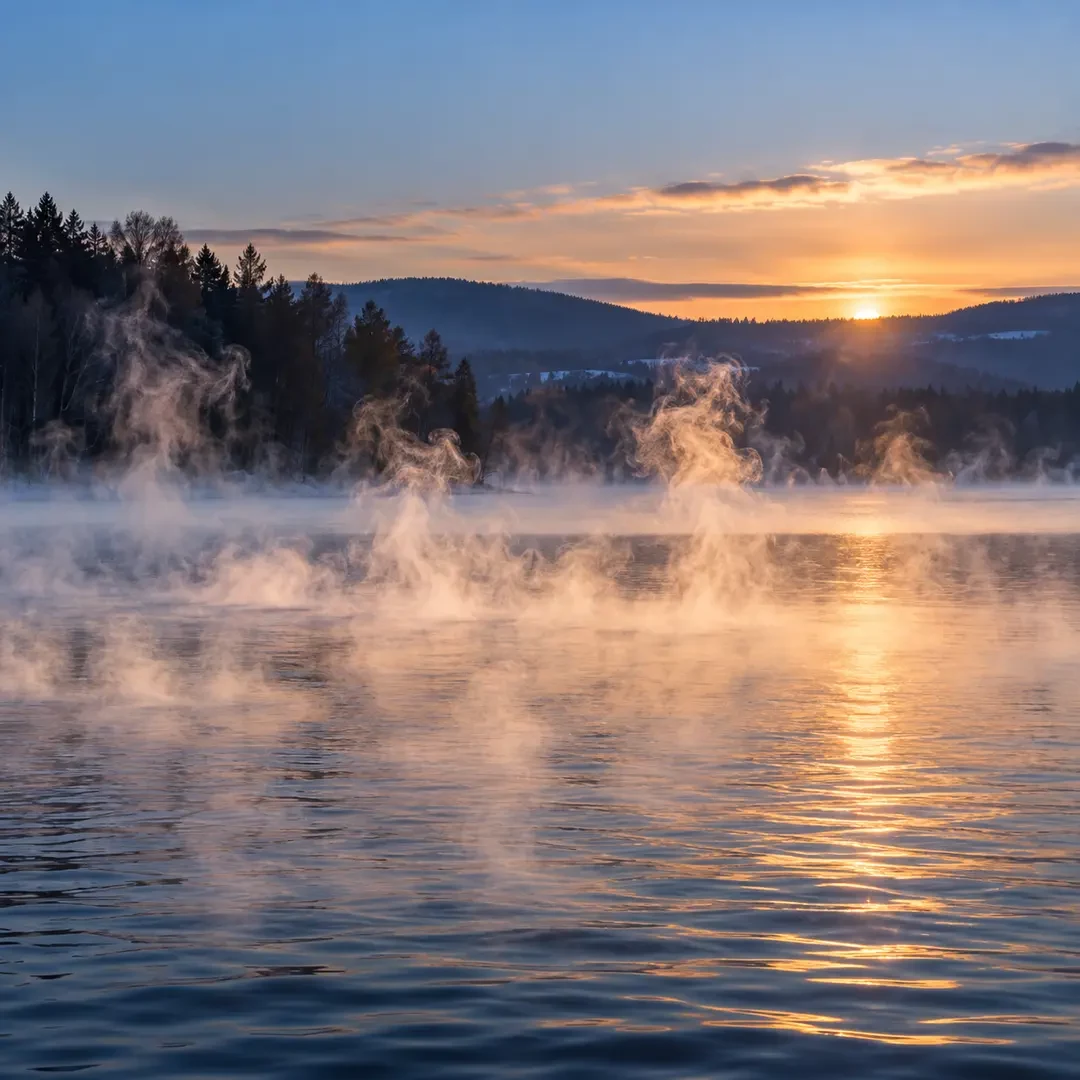
On a cold morning, a lake, river or stretch of sea may appear to be smoking. White wisps rise a short distance, twist and vanish into the air. This is not combustion, the water is not boiling, and it is not necessarily a large bank of fog arriving from elsewhere. The phenomenon is called steam fog, evaporation fog or, in strong marine cases, sea smoke.
The temperature contrast that starts it
The classic set-up combines very cold air with water that is relatively warmer. “Warmer” does not mean hot: the water only needs to be appreciably warmer than the air moving across it. Water evaporates from the surface and adds vapour to the lowest layer of air.
The air touching the water gains moisture and some heat. When that warm, moist sliver mixes with the colder, drier air around it, the mixture reaches saturation. Some vapour condenses into tiny suspended droplets that scatter light and become visible as fog. Shallow rising currents created by the temperature contrast arrange those droplets into smoke-like streamers.
Why it is usually shallow and patchy
Steam fog often occupies a thin layer. Plumes rise from the surface, then mix with drier air and may evaporate again. The sky can remain clear while moving veils cover parts of the water.
A light flow helps create the necessary mixing. With no air movement, exchange may be weak; with stronger wind, droplets can be dispersed or carried away quickly. The outcome depends on the water–air temperature difference, existing humidity, wind and stability near the surface.
Steam fog is not ordinary sea fog
Both occur over water, but the thermal arrangement is reversed. Steam fog forms when cold air crosses relatively warmer water and receives moisture from below. Advection sea fog forms when mild, humid air moves over colder water and is cooled to saturation. Advection fog can make an extensive, persistent layer; steam fog more often appears as low, turbulent wisps.
Where and when it appears
- Over lakes, reservoirs and rivers during outbreaks of cold air.
- Over coastal waters and seas when the temperature contrast is large.
- Above heated outdoor pools in cold conditions.
- Most commonly in autumn and winter, although the contrast—not the calendar—is the key ingredient.
Open water may look “warm” only in comparison with the air. Visible fog does not show that the water is safe for swimming, nor does it prove that the surface is about to freeze.
Visibility, icing and safety
Even a shallow fog layer can reduce visibility abruptly over water and near shore. Boaters should slow down, monitor lights and landmarks and check local warnings. Nearby roads can also encounter small banks that drift inland.
When air temperatures are below freezing, droplets may remain supercooled and deposit ice on exposed surfaces. The sight of steam fog is not a substitute for an official warning: check visibility, temperature and alerts from the relevant weather service before travelling.
The most useful visual clue
Wisps that originate directly at the water and fade a short distance above it are the classic sign. The scene looks smoky because visible condensation is moving through the air; water vapour itself is invisible. It is a compact demonstration of heat and moisture exchange at the boundary between water and atmosphere.
Technical sources: official explanations from the US National Weather Service and the Met Office.