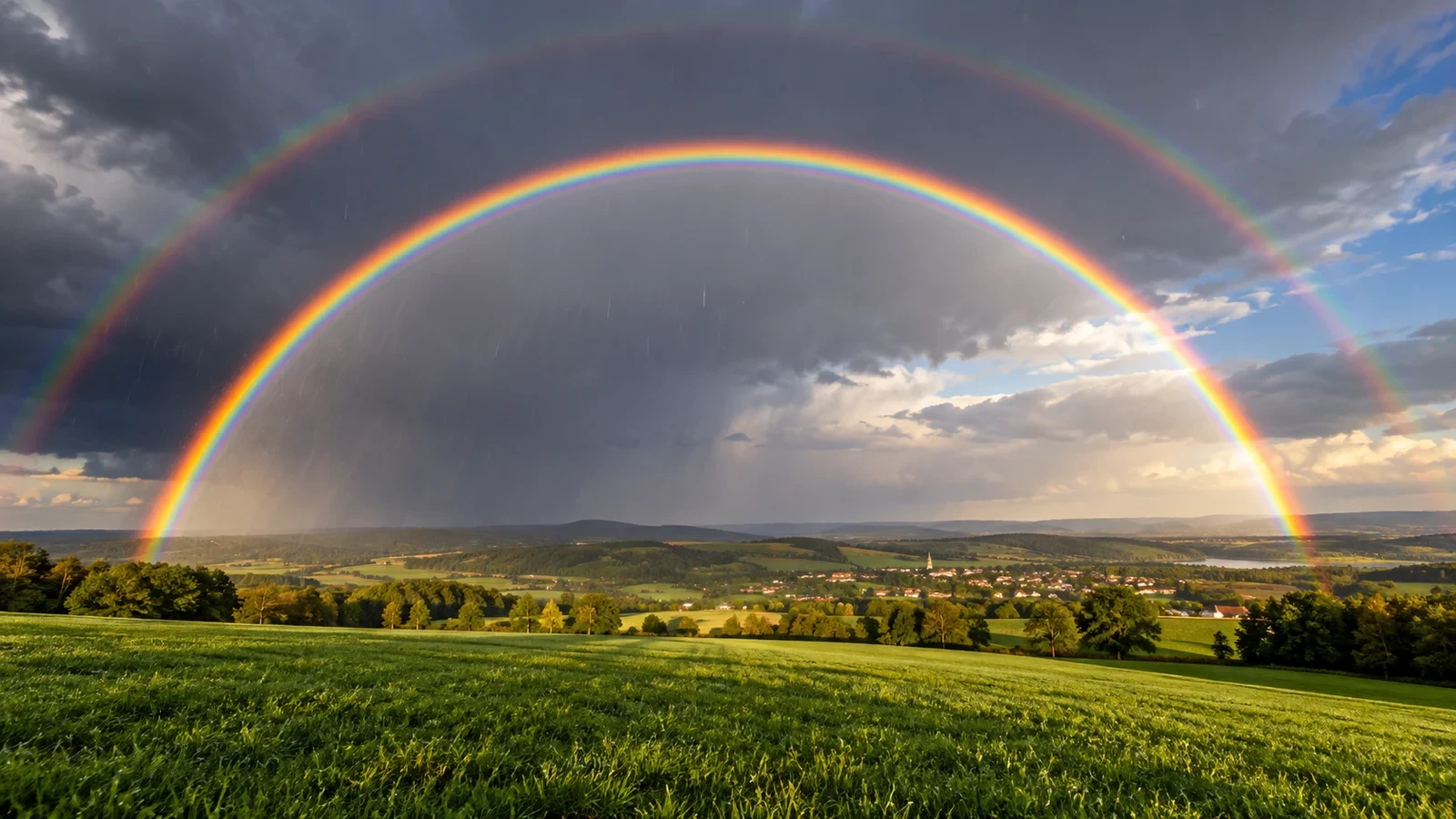
A rainbow looks like an object placed in the distance, yet it is an optical phenomenon defined by light, water droplets and the observer’s position. Two people standing apart therefore do not see precisely the same bow, even when they face the same rain shower.
What happens inside a droplet
Sunlight changes direction as it enters water from air; this is refraction. Part of the light reflects from the back of the droplet and leaves through its front, refracting again. Different wavelengths bend by slightly different amounts, separating white light into a continuous spectrum.
Millions of droplets send light in many directions. The eye receives a strong concentration only from droplets at particular angles. In the primary bow, the brightest light arrives at roughly 42 degrees from the antisolar point—the direction directly opposite the Sun. In practice, put the Sun behind you and look towards illuminated rain.
Why red is outside and violet inside
In a primary rainbow, red light is deviated less and appears at the outer rim; violet is deviated more and lies on the inner edge. The bands are not truly separate stripes. The spectrum is continuous, although human vision groups it into familiar colours.
A rainbow is a circle, not half a circle
The geometry creates a cone of light with the observer’s eye at its tip. The visible rainbow is the circumference where that cone meets a field of droplets. From the ground, the horizon blocks the lower section, so we normally see an arc. From an aircraft, mountain or tall building, with droplets below the observer, much more of the circle—and occasionally all of it—can be visible.
Its centre lies at the antisolar point. When the Sun is high, that point is far below the horizon and the visible bow is small or absent. Near sunrise or sunset, the low Sun allows a tall bow to fill the sky.
What makes a double rainbow
A secondary bow forms when light reflects twice inside each droplet rather than once. The extra reflection loses intensity, making the outer bow fainter. Its colour order is reversed: red lies on the inner side and violet on the outer side.
The sky between the bows can appear darker. This is Alexander’s band, produced because fewer rays are directed towards the observer at those angles; it is not a special dark cloud.
Best conditions for seeing one
- The Sun must shine from behind the observer.
- Rain, drizzle, spray or suspended droplets must lie ahead.
- A relatively low Sun produces a higher and more complete arc.
- Dark cloud behind the rain improves contrast but does not create the bow.
- Larger raindrops often give brighter colours; very small droplets blur them together.
Can you reach the end?
No. A rainbow has no fixed geographical position or reachable end. As you move, a different set of droplets sends light towards your eyes, so the bow moves with you. A nearby camera also records a slightly different rainbow because its viewpoint is not identical.
Fogbows and moonbows
Tiny fog droplets can create a broad, whitish fogbow because their colours overlap strongly. Bright moonlight can also create a moonbow when droplets are correctly positioned. It often looks white to the unaided eye because colour vision is weak in low light, although a long camera exposure may reveal colour.
The World Meteorological Organization classifies rainbows as photometeors in its International Cloud Atlas. No instrument is needed to interpret one: keep the Sun behind you, find illuminated precipitation ahead and remember that the bow belongs to the geometry linking the light, the droplets and your position.