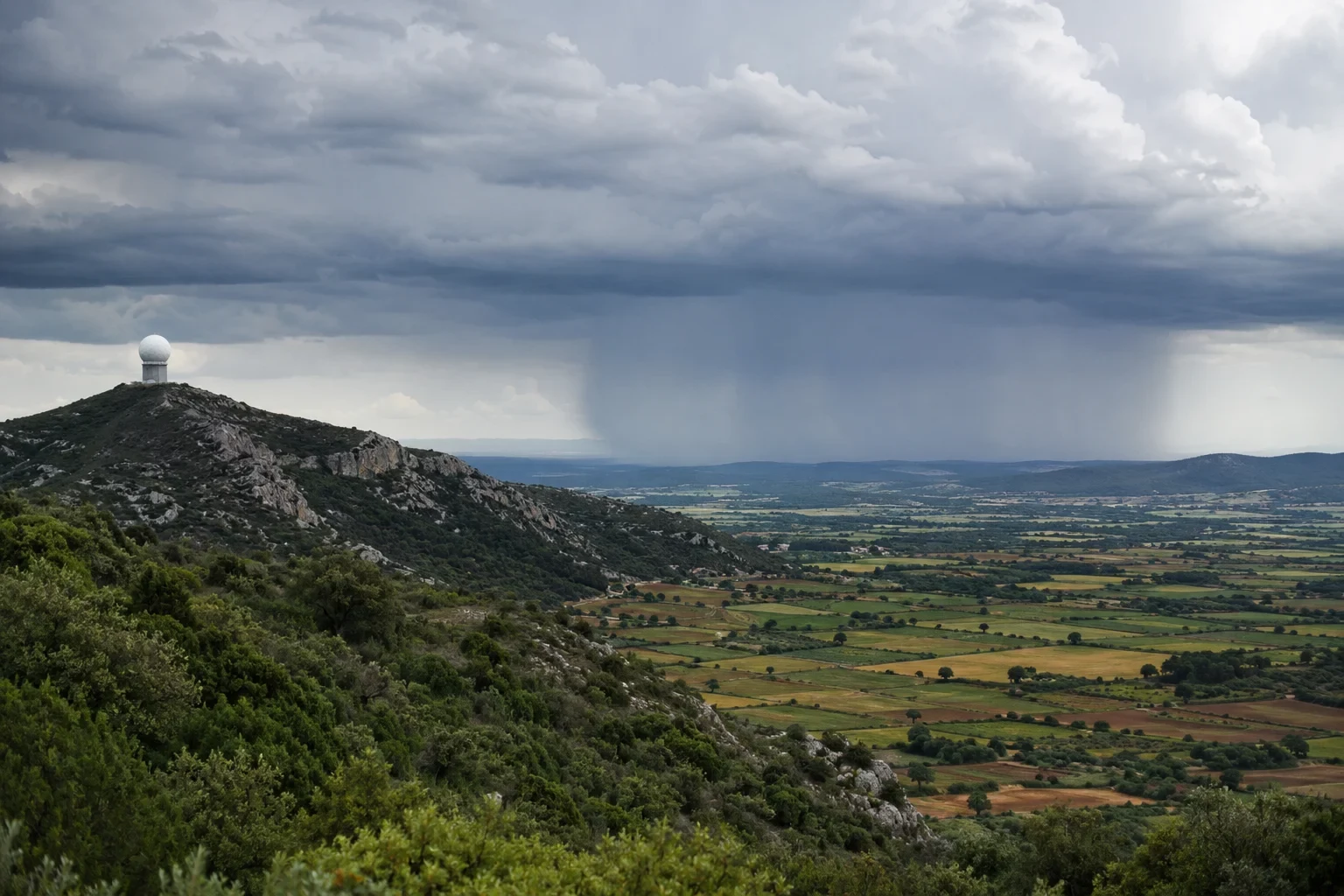
Radar helps you follow precipitation, but a coloured patch alone cannot answer “will it rain on my street?”. You need to know the product, its timestamp and how it evolves. This is an educational guide, not a report of current weather.
Identify the product and units first
AEMET offers reflectivity, echo-top height and precipitation accumulation products. They mean different things: reflectivity uses dBZ, echo-top height uses kilometres, and accumulation uses millimetres. Red on a radar map is not an AEMET red weather warning. Read the legend for the particular map.
What radar observes
Radar sends a signal and receives some of the energy reflected by particles such as raindrops, snow or hail. This information supports precipitation estimates. It is neither a photograph of the rain reaching the ground nor a rain-gauge measurement at your home.
How to check an animation
- Locate your destination and route, not just your current position.
- Check the date, time and stated time zone.
- Play several frames to see whether echoes approach, move away or change size.
- Check whether the sequence shows past observations or a forecast; some applications combine both.
- Compare it with the forecast and official warnings.
A practical example
Suppose you plan to leave at 18:00 and a screenshot shows rain west of your destination. The still image does not reveal its direction. If the animation shows eastward movement, check again closer to departure. You still cannot infer an exact arrival time: precipitation cells can develop or weaken. This is a hypothetical example, not a forecast.
Mistakes to avoid
Do not compare colours across applications without reading their scales. Do not confuse a six-hour accumulation with rain falling now. An area without echoes does not guarantee dry weather: radar has limitations and data may be incomplete. Estimates depend, among other factors, on precipitation type and how it is observed.
A useful check before leaving
Use radar, the local forecast and warnings together. If they disagree, check timestamps, units and coverage before drawing conclusions. Read our guide to warning colours to understand Spain’s official danger levels.