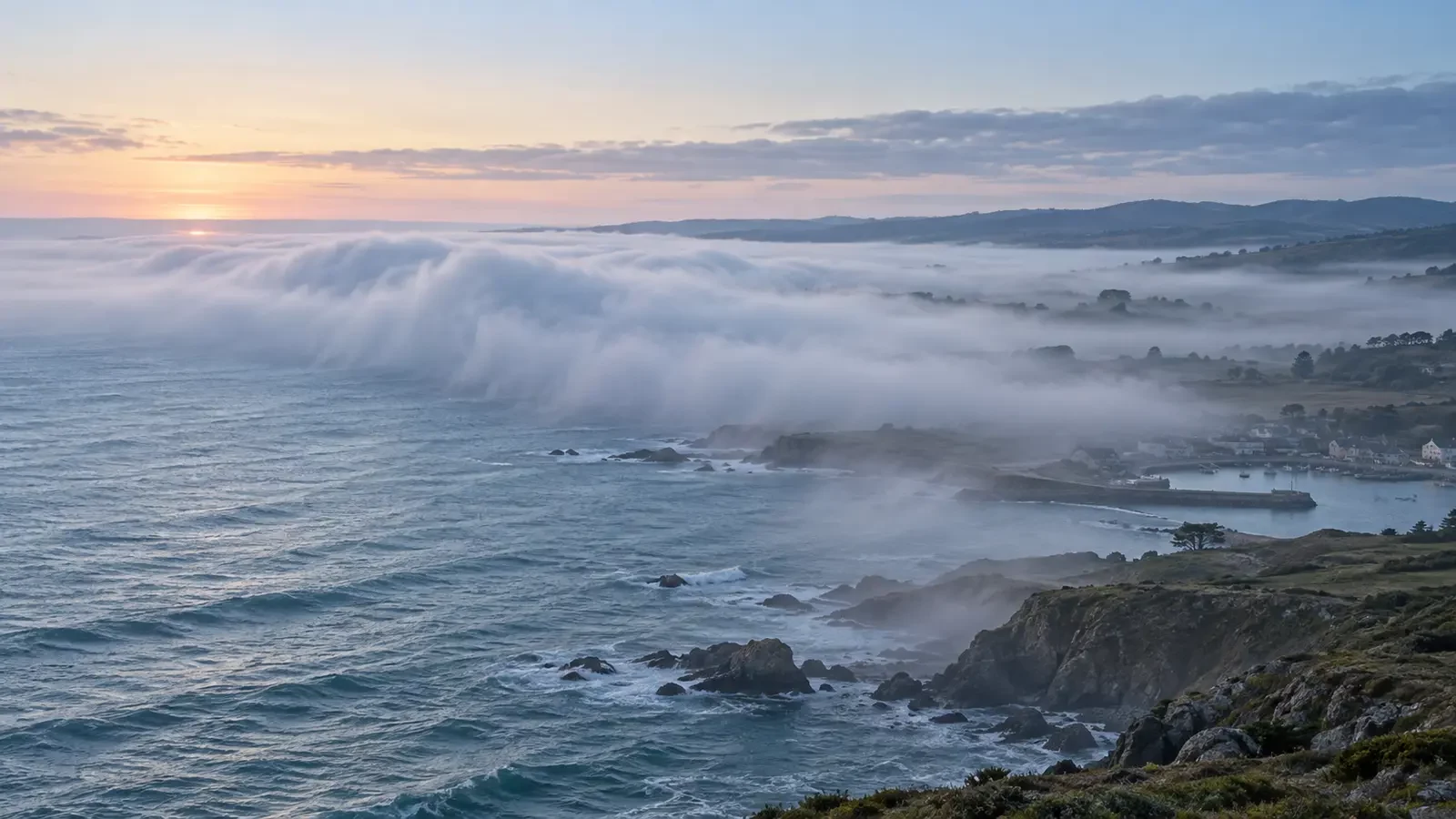
A clear morning inland can coincide with a coast hidden beneath a low, compact and mobile layer. The cause is often advection fog: moist air carried horizontally by the wind and cooled as it crosses a colder surface. It is common near the sea, but it can also form over cold ground or snow cover.
What “advection” means
In meteorology, advection is the horizontal transport of an atmospheric property, such as temperature or moisture, by the wind. Humidity alone is not enough. A relatively mild, moist air mass must move across a surface that cools it to its dew point. Once the air becomes saturated, some water vapour condenses into tiny suspended droplets and visibility falls.
On a coast, the process may begin over cold water or an area of coastal upwelling. The wind can then carry the layer towards beaches, harbours and valleys open to the sea. This is why the bank may look like a wall that advances, retreats or breaks apart as wind and terrain change.
How it differs from radiation fog
Radiation fog usually forms on clear, calm nights when the ground loses heat and cools the air immediately above it. It is often local and may clear after sunrise. Advection fog requires horizontal air movement and can survive moderate wind. Daytime warming does not guarantee clearance: if moist air continues to arrive over a cold surface, the fog still has a supply mechanism.
Why it may last for many hours
Its persistence depends on the balance between moisture, temperature, wind and vertical mixing. It is more likely to continue when:
- the sea or ground remains distinctly colder than the incoming air;
- the airflow continuously supplies moist air;
- an inversion limits mixing with drier air above;
- terrain channels the bank towards a coast or estuary.
It can clear when the wind changes and cuts off the moisture source, when the surface warms sufficiently, or when stronger mixing introduces drier air. Very light wind may stop the bank from moving inland; stronger wind can sometimes lift the fog into low stratus rather than remove the cloud altogether.
Reading forecasts and observations
Daytime satellite imagery can reveal the extent of low cloud, although separating fog from low stratus requires context. Coastal stations provide visibility, humidity, wind and cloud-base observations. In a forecast, look for terms such as “coastal fog”, “low cloud”, “poor visibility” or “onshore flow”, and check both the expected onset and the stated trend.
The difference between air temperature and sea-surface temperature is a clue, not a complete forecast. The air must also contain enough moisture, and the wind direction must carry it across the colder surface. A general weather app may show overcast conditions without capturing sharp visibility changes at a headland or harbour.
Hazards for roads, coasts and transport
The main impact is a rapid and uneven loss of visibility. A coastal road may change from clear conditions to dense fog within a few kilometres. Reduce speed smoothly, increase following distance and use the fog lighting required by local rules. Main beam headlights often make vision worse because their light scatters back from the droplets.
At sea, fog makes it difficult to judge distance and identify other vessels or the shoreline. Navigation should follow the relevant official warnings, procedures and equipment requirements rather than relying on visual references alone. Ports and airports may also face delays when visibility or cloud ceiling falls below operational limits.
A fog forecast that starts with the wind
To anticipate advection fog, follow a sequence: where the air comes from, how much moisture it carries, which surface it will cross and whether the wind will maintain that route. Time of day matters, but less than it does for radiation fog. A coastal bank can move inland during the afternoon, remain overnight and persist beyond sunrise.
The practical lesson is simple: if coastal fog is forecast, do not assume the sun will clear it quickly. Check official warnings, recent observations and changes in wind before driving, sailing or beginning an activity by the sea. Advection fog moves, and its edge may shift quickly even while conditions look settled only a short distance away.