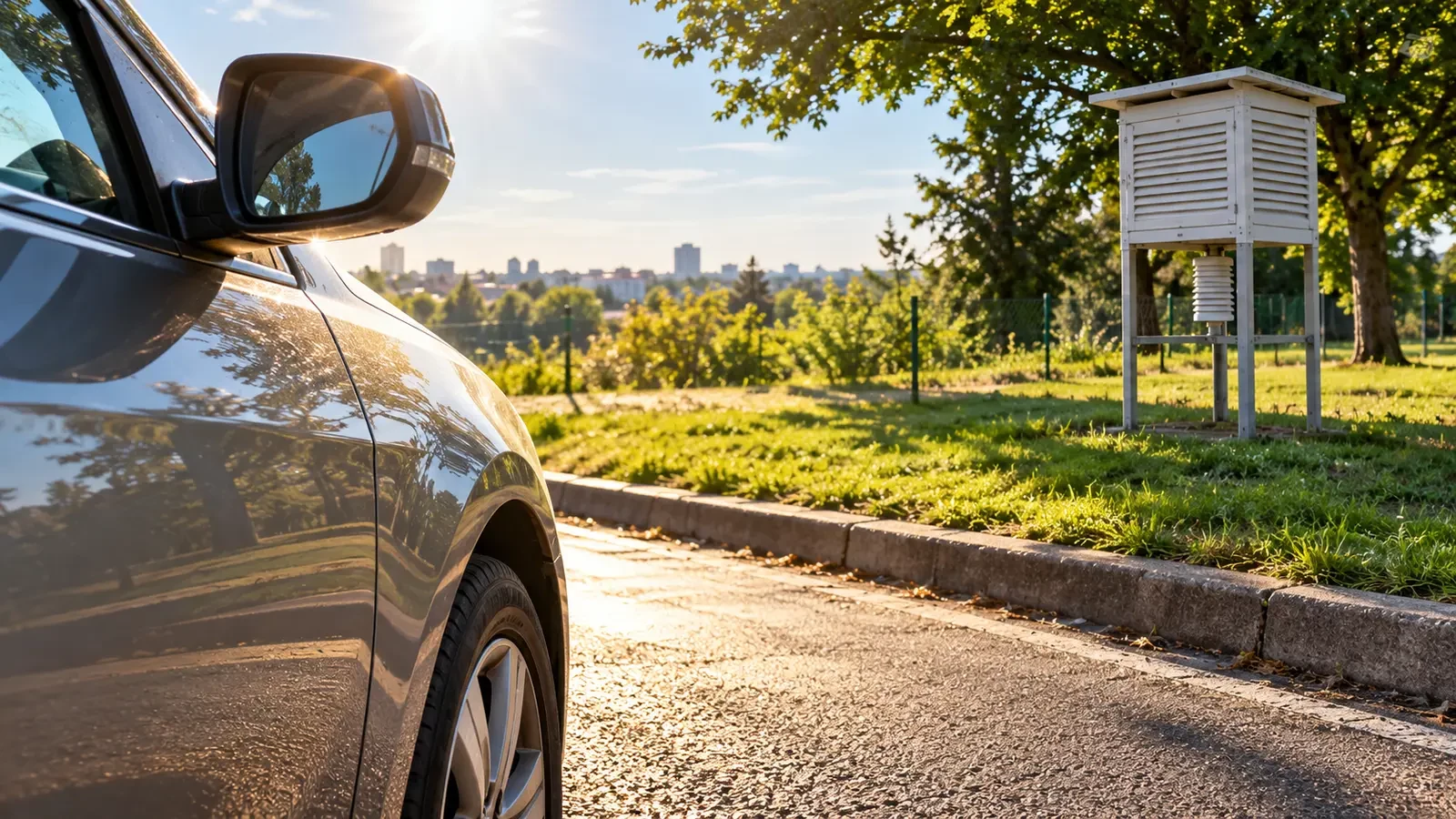
Your weather app says 18°C, the car displays 21°C and a balcony thermometer reaches 24°C. None of them must necessarily be faulty. Although we speak of “the temperature” of a place, each figure may describe a different point, height, surface and time.
What official air temperature means
Weather networks do not put thermometers just anywhere. To make observations comparable, a sensor is placed inside a ventilated screen that shields it from direct sunlight and rain, over suitable ground and at a standard height. The Met Office, for example, measures air temperature 1.25 metres above the ground inside a Stevenson screen.
The aim is to measure the air flowing around the instrument, not how hot an object becomes in sunshine. An official reading can therefore be far lower than the temperature of a wall, terrace, dashboard or road surface.
What the car thermometer measures
A car uses an external sensor, usually fitted somewhere around the front of the vehicle or beneath a mirror, depending on the model. It attempts to sample ambient air but is surrounded by materials that absorb and release heat. Warm tarmac, sunlit bodywork, the engine and stagnant air while parked can all push the reading upwards.
Once the car starts moving, airflow ventilates the sensor and the value often moves closer to ambient temperature. A lag may remain because the sensor needs time to adjust after leaving a garage, entering colder air or moving between sunshine and shade.
In winter, the situation can reverse. A car under a clear sky may cool sharply, while residual engine heat or a nearby surface influences the sensor. The display is useful as a warning that freezing conditions may be near, but it is not a standard meteorological measurement and does not prove that the road is icy.
What a weather app displays
An app may show an observation from a nearby station, a model estimate for a grid cell, or a blend of several sources. Its reference point may be kilometres away, at a different altitude or in another setting such as an airport, city centre, coast, valley or hillside.
Timing matters too. The station may have reported several minutes earlier while the car is sampling now. Some apps round the location or value, and others show the forecast for the current hour rather than a live observation.
Microclimates change over short distances
Dark paving in sunshine warms the air immediately above it; damp grass is often cooler; walls store heat; hollows collect cold air at night; and a breeze may reach one street but be blocked from the next. Buildings and paved surfaces can also release stored heat after sunset.
Height matters. On clear, calm nights, the ground may cool rapidly and air close to it can be colder than air at the official sensor height. During the day, a sunlit balcony can show the opposite effect.
How to compare readings fairly
- Check whether the app says observed, current or forecast, and note the update time.
- Find the reference station and consider its distance, altitude and surroundings.
- Drive for a few minutes before judging the car’s outside-temperature reading.
- Do not compare a thermometer in sunshine or beside a wall with a screened, ventilated station.
- For a home sensor, choose permanent shade and airflow, away from roofs, walls, air-conditioning outlets and paving.
- For ice, heat or fog risk, also consult warnings and dedicated observations; one temperature cannot describe the entire hazard.
Which value is correct?
It depends on the question. Use official observations to compare places, records and trends. The car sensor offers a local reference around the vehicle, with the limitations above. An app is most useful for planning ahead when you understand its source and distinguish an observation from a forecast.
Different figures are usually not a contradiction. They reveal how sharply the atmosphere and surrounding surfaces can vary locally. Before calling a reading wrong, ask where, how and when it was measured.