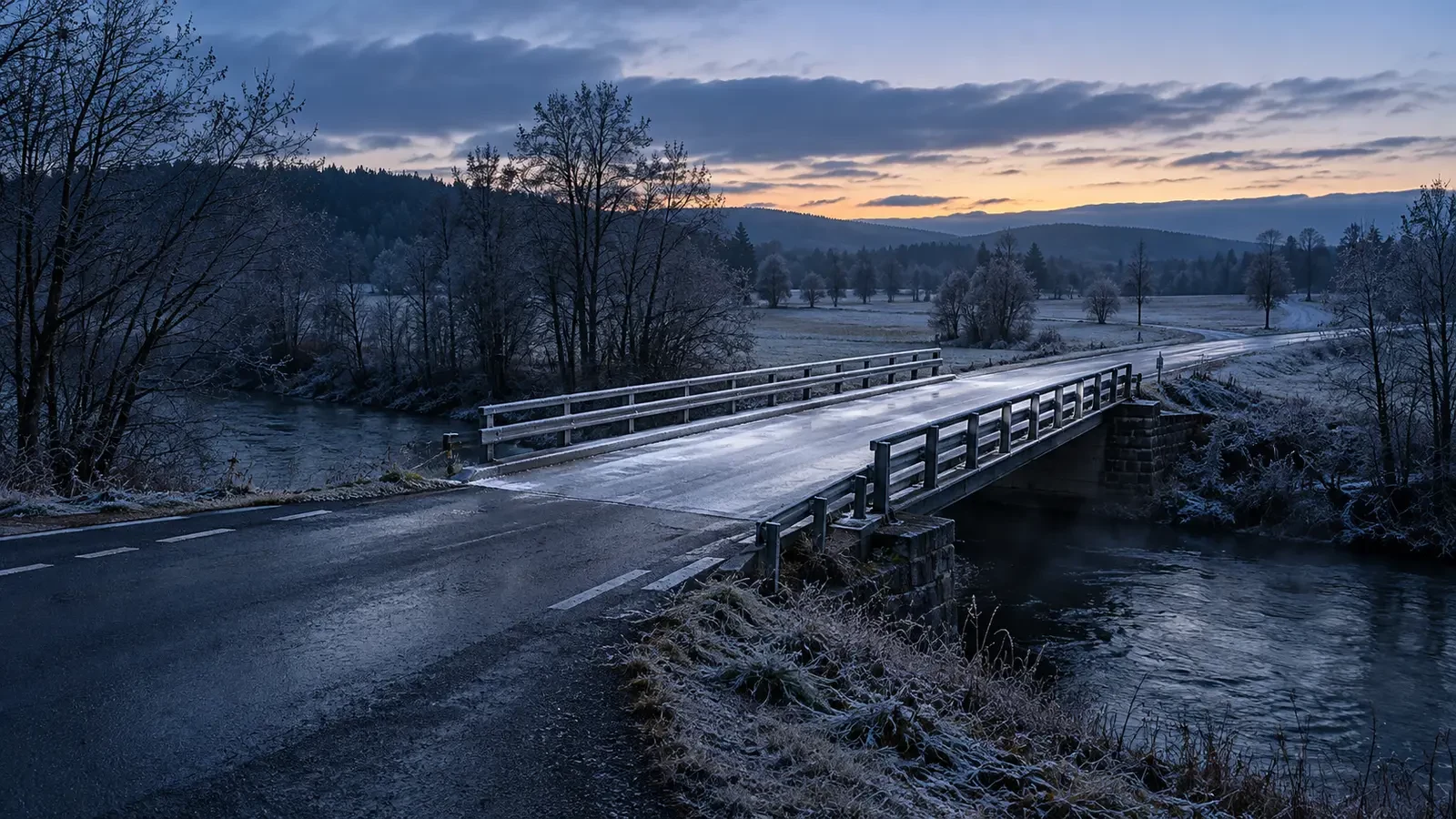
The road looks merely wet and the car still has good grip. A few metres later, the bridge deck may be icy. The warning is not an exaggeration: a bridge exchanges heat with cold air above and below, while a road built on the ground retains some warmth from the soil beneath it.
The ground acts as a heat reservoir
During the day, the ground absorbs energy. As air temperature falls, stored heat is released slowly and can delay cooling at the road surface. An ordinary road sits on layers of soil and rock and remains thermally connected to that mass.
A bridge, flyover or viaduct has no comparable reservoir beneath its deck. Cold air surrounds both sides and wind carries heat away from above and below. Under clear skies, the surface also loses energy by radiation and may cool still further.
Air temperature is not road temperature
A car display showing a few degrees above freezing does not guarantee an ice-free bridge. Surface temperature depends on the material, exposure to the sky, wind, moisture and the heat balance over previous hours. On clear nights, a road surface can become colder than the air.
The reverse delay also matters. After air temperature rises, a structure that cooled for hours may remain cold. Rain, drizzle, fog droplets or condensation can then freeze on contact with the deck.
Why rivers and valleys can increase the risk
Many bridges cross water or low-lying ground, where humidity, fog and pools of cold air can be more common. Shade from trees, hills or structures reduces solar warming, particularly in winter when the sun is low.
Wind does not create ice by itself. Water on the deck still needs a sufficiently cold surface to freeze. Wind does, however, increase heat exchange and can help the exposed deck cool more quickly and remain cold.
Nearly invisible ice
A thin, smooth film can be difficult to see, especially at night. It is often called black ice because the dark road remains visible beneath transparent ice. It may result from freezing rain, refrozen meltwater, dew, fog or residual moisture.
Indirect clues include an unusual shine, frost on railings and vegetation, a sudden lack of spray from vehicles ahead or a low-temperature warning. None replaces official warnings or verified road-condition information.
When to be especially cautious
- At night, around sunrise and after sunset.
- When temperature is near freezing or falling quickly.
- After rain, melting snow, dense fog or drizzle.
- On shaded bridges, north-facing sections, river crossings and valley roads.
- After a prolonged cold spell, even when the air begins to warm.
Crossing a potentially icy bridge
The important decision is made before the bridge. Reduce speed progressively while the approach still offers grip, increase the following distance and disengage cruise control. On the deck, keep steering, throttle and braking inputs smooth.
Avoid sudden lane changes or harsh braking. If grip is lost, ease off the accelerator, look towards the safe path and make measured corrections without oversteering. ABS and stability control can help, but they cannot create grip on an extremely slippery surface.
If authorities advise against travel or widespread ice is present, postpone the journey or use a treated route. Suitable tyres in good condition and at the correct pressure improve the margin, but they do not remove the hazard.
The key point
Bridges freeze first because cold air surrounds the deck and there is no warm ground underneath. A wet-looking road can therefore become slippery exactly where the bridge begins. Slowing down before entry and avoiding abrupt manoeuvres is far more effective than trying to react once the vehicle is already on ice.