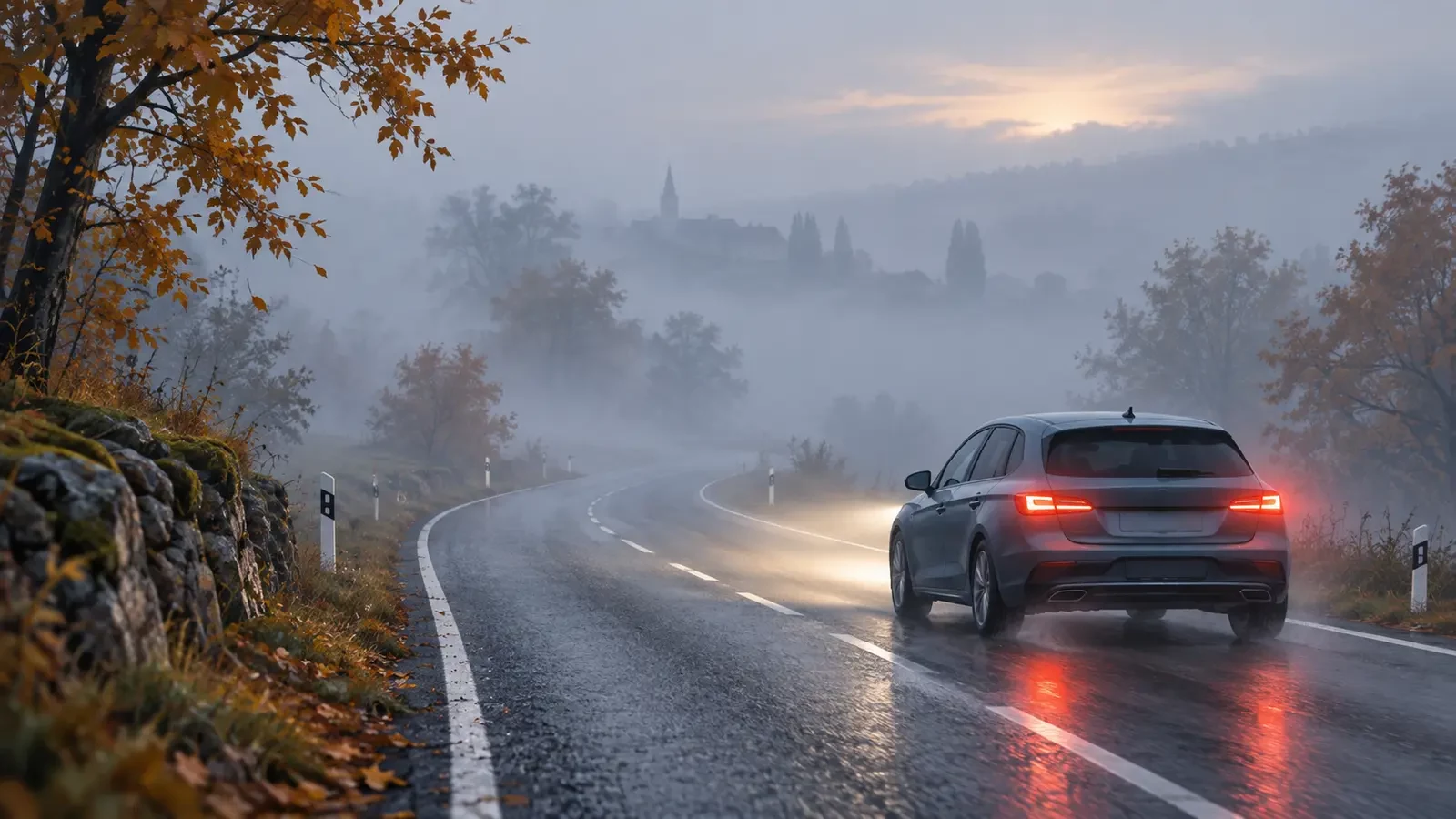
Fog can turn a familiar road into a difficult environment within seconds. It does more than shorten the view of vehicles, bends and hazards: it removes visual references, distorts the sense of speed and often leaves the road damp. Safe driving is not about using the car ahead as a guide. It is about restoring enough time and space to stop within the road you can actually see.
Before entering a fog bank
When visibility begins to fall, reduce speed smoothly before the fog becomes dense. Check your mirrors, open the gap to traffic ahead and switch on the appropriate lights. Avoid sudden braking, because following drivers may discover the slower traffic later than you did.
Use ventilation or the demister if moisture begins to cloud the inside of the windows. A clean windscreen matters: dirt and condensation scatter light and reduce contrast, especially in darkness.
Which lights should you use?
- Dipped-beam headlights: these are the foundation for seeing and being seen. Do not rely only on daytime running lights, as the rear of some vehicles may remain poorly lit.
- Front fog lights: where fitted, they may improve low and lateral illumination when visibility is seriously reduced.
- Rear fog light: reserve it for dense fog or genuinely poor visibility. It is very bright and can dazzle other drivers when conditions improve or traffic is close.
- Main beam: do not use it in fog. The light reflects from suspended droplets and creates glare, often making the view worse.
Turn fog lights off once they are no longer needed. The aim is to be visible without creating unnecessary glare.
Speed: stop within the distance you can see
There is no single safe speed for fog. A useful rule is that you must be able to stop within the stretch of road that is clearly visible. As the visible distance becomes shorter, your speed must fall too.
Check the speedometer regularly. With few external references, drivers may travel faster than they realise. Keep a steady pace, avoid abrupt inputs and disengage cruise control when conditions require frequent adjustment.
Create space and minimise manoeuvres
Increase the following distance substantially. Chasing the rear lights of another vehicle creates a false feeling of guidance and removes reaction time. Avoid overtaking unless it is essential and the whole manoeuvre can be completed with adequate visibility.
Road markings on the left or right edge can help maintain position, depending on the country, but do not stare at a single line. Scan both near and farther ahead for cyclists, pedestrians, slow vehicles, queues and changes in the road layout.
Where fog is most likely
Fog often develops or lingers in valleys, river corridors, hollows, wooded areas and near lakes or reservoirs. It can be highly localised, so clear conditions may give way to a compact bank within a very short distance. Dawn, night-time, humid periods and light winds are common settings.
On bridges and cold stretches, moisture may coincide with temperatures close to freezing. In that situation, consider a risk of ice even when the air temperature is slightly above zero.
Common mistakes
- Using main beam in an attempt to see farther.
- Following the vehicle ahead too closely.
- Stopping on the hard shoulder without a genuine emergency.
- Changing lanes repeatedly or overtaking with incomplete sight lines.
- Assuming automatic lighting will always interpret the conditions correctly.
- Leaving the rear fog light on after dense fog has cleared.
When to leave the road temporarily
If you can no longer maintain a safe stopping margin, pausing the journey may be the right decision. Do not stop in a live lane and avoid remaining on the shoulder except in an emergency. Take an exit or use a service area, car park or another place physically separated from moving traffic, then wait for visibility to improve.
Official road-safety guidance consistently emphasises dipped headlights, a lower speed and a larger following gap. The objective is not to keep moving at all costs, but to preserve enough space and time to react to hazards that have not yet appeared through the fog.