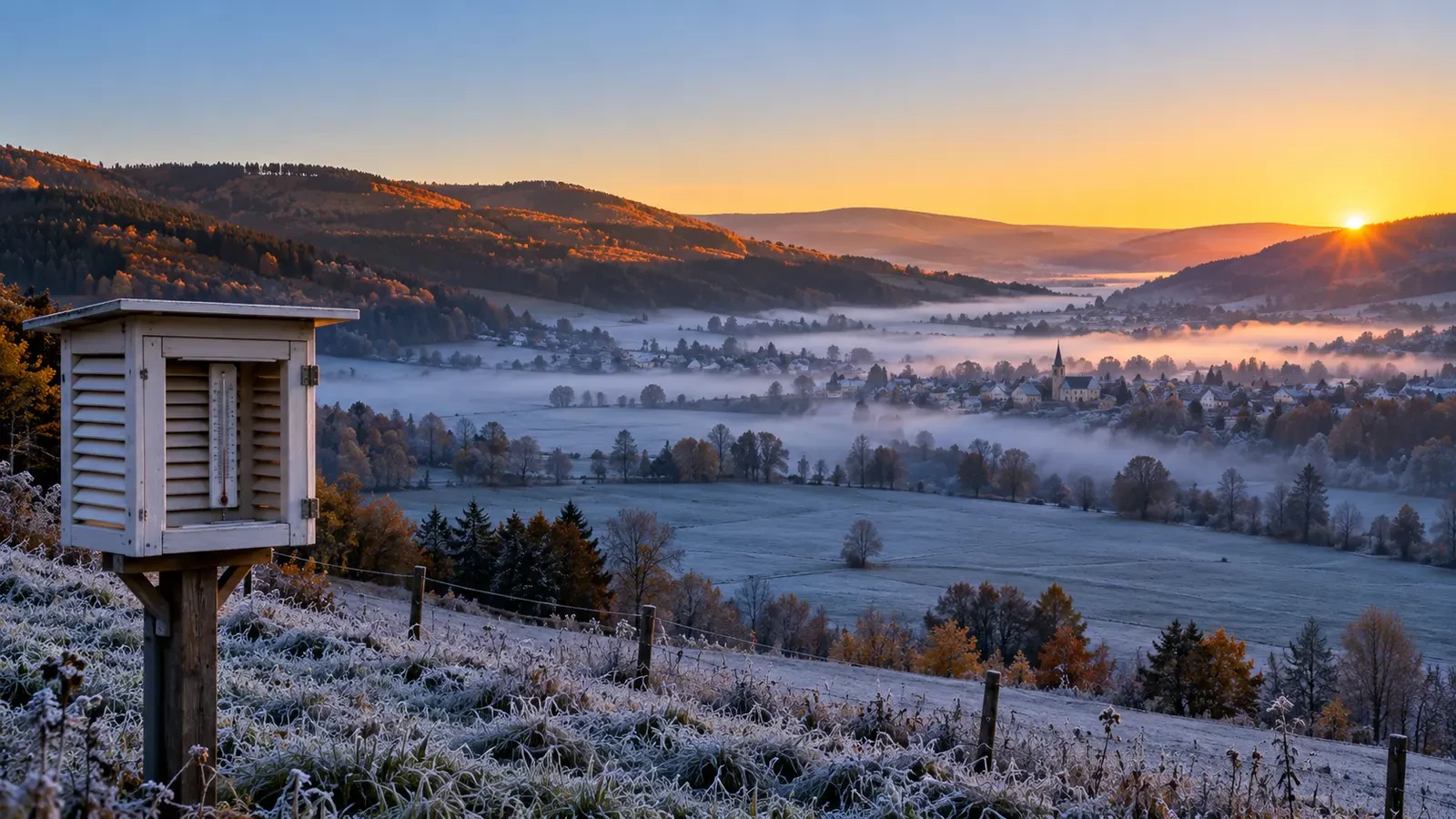
It is tempting to assume that night ends as soon as the Sun appears and that temperature must rise immediately. Yet on many clear mornings the daily minimum occurs shortly before sunrise or even several minutes afterwards. The key is not whether the Sun is visible, but the balance between energy lost by the surface and the small amount it begins to receive.
The ground cools through the night
After sunset, the ground no longer receives direct solar radiation but continues to emit infrared energy. When it loses more energy than it gains from the atmosphere, its temperature falls. Air touching the ground cools through heat exchange, creating a shallow cold layer. The US National Weather Service describes this nocturnal cooling and how wind mixes cold surface air with somewhat warmer air above.
Sunrise is not instant heating
At geometric sunrise the Sun is extremely low. Its rays pass through more atmosphere and strike the surface at a shallow angle, so the incoming energy per square metre remains weak. At first, this gain may still be smaller than continuing radiative losses. While the net balance remains negative, the ground and adjacent air can continue to cool.
Temperature begins to recover when absorbed sunlight exceeds those losses. The timing of the minimum therefore varies with season, latitude, slope orientation, cloud, wind and the nature of the surface.
Conditions that favour a late minimum
- Clear sky: allows efficient radiative loss from the surface.
- Light wind: limits mixing with milder air above.
- A long night: gives more time for cooling.
- Relatively dry air: often permits a larger fall, although moisture and fog formation can modify the curve.
- Valleys and hollows: dense cold air can collect in low ground.
Cloud and wind can change everything
Cloud acts like a blanket by returning some infrared radiation towards the surface. Cloudy nights generally cool less than clear ones. Wind can also slow the fall by stirring the shallow cold layer into less-cold air above. If wind increases or changes before dawn, temperature may level off or rise without any help from direct sunshine.
Why thermometers disagree
Official air temperature is measured under standard exposure, shielded from radiation and at a specified height. A sensor on the ground, a vehicle roof or beside a wall can report something else. Grass and exposed surfaces may cool below the air temperature measured higher up, especially on calm clear nights.
Reading the forecast minimum
A forecast low is the lowest value expected over a period; it is not necessarily the temperature at midnight or exactly at sunrise. For an early activity, check the hourly curve, cloud, wind and dew point. The Met Office explanation of radiation fog also shows why clear, moist and lightly windy nights can cool towards saturation.
The central idea
Sunrise is an astronomical instant; warming is an energy response. The two need not coincide. Temperature stops falling only when the surface begins to gain more energy than it loses, and that moment changes from one morning to another.