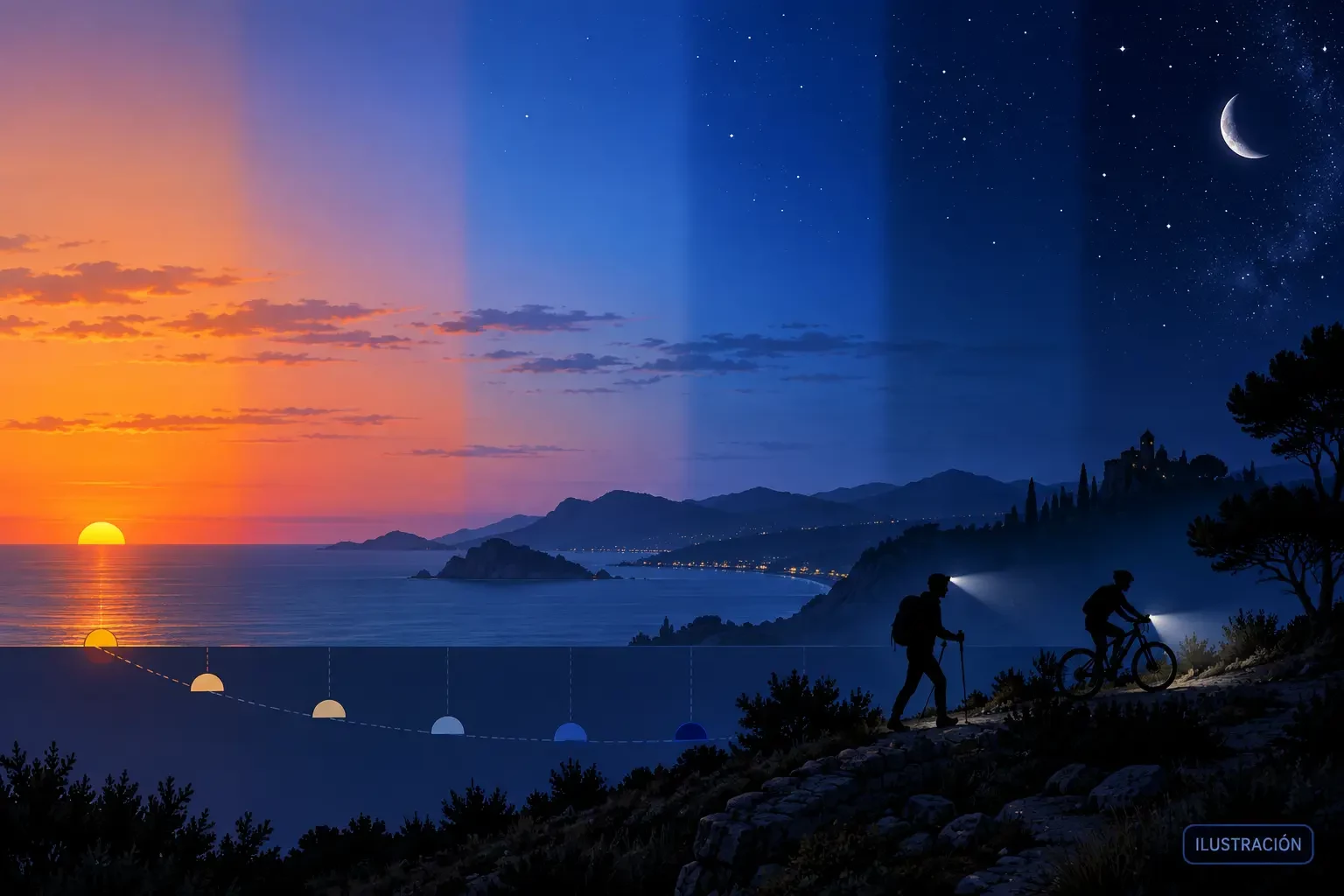
Sunset does not mark the instant when everything becomes dark. After the Sun disappears, the atmosphere continues to scatter sunlight while the Sun is below the horizon. This interval is twilight, divided into three stages. They are useful for hiking, cycling, photography, navigation and outdoor work, but no stage guarantees safe visibility.
The definitions below are permanent astronomical conventions. They are not a weather warning and do not replace a forecast, terrain information or official instructions.
Sunset is not immediate darkness
Published sunset times are calculated for an ideal horizon. A mountain, building or forest may hide the disc earlier, while an open western horizon preserves direct sight for longer. Atmospheric refraction is also included in apparent rise and set conventions.
Once the Sun is hidden, the upper atmosphere remains illuminated and light fades gradually. For practical planning, check both sunset and the end of evening civil twilight.
Civil twilight: the first stage after sunset
Evening civil twilight runs from sunset until the geometric centre of the Sun reaches 6 degrees below the horizon. In clear conditions, the horizon and many terrestrial objects can usually be distinguished while the brightest stars and planets appear.
This is the most useful reference for everyday activity, but it does not mean “guaranteed usable light”. Thick cloud, fog, rain, mountain shade, dense woodland or tall buildings can darken the scene earlier. On rough ground or a bicycle, switch on lights before you depend on them.
Nautical twilight: outlines rather than detail
Nautical twilight covers solar depression from 6 to 12 degrees. Its name comes from the period when the horizon could still be compared with suitable stars for navigation. On land, broad silhouettes may remain visible, but path detail, obstacles and surface changes become difficult without artificial light.
It is not a sensible reserve for finishing an unlit route. If the plan extends into this stage, lighting, battery capacity and dependable navigation should already be available.
Astronomical twilight and night
Astronomical twilight covers 12 to 18 degrees below the horizon. To a casual observer the sky may already look like night, especially in a city. Once the Sun is more than 18 degrees down, solar twilight contributes very little and astronomical night begins.
That is not necessarily total darkness: moonlight, stars, light pollution, snow or aurora can illuminate the scene. Conversely, a moonless cloudy night in an enclosed valley may be much darker.
How many minutes does twilight last?
There is no universal answer. Duration depends mainly on latitude and season because the angle at which the Sun’s apparent path crosses the horizon changes. Near the equator the descent is usually steeper and twilight shorter. At high latitudes, particularly near summer, it can be shallow and prolonged. Parts of northern Europe may not reach astronomical night around the solstice.
Use times calculated for the exact location and date. Do not transfer a value from another city, and check that the time zone is correct.
Weather and terrain change usable light
- Cloud and precipitation: reduce sky brightness and contrast.
- Fog: shortens visibility and may reflect a headlamp beam.
- Terrain: slopes and cliffs advance shade; exposed ridges may add wind risk.
- Woodland and streets: tree crowns and buildings block much of the sky.
- Surface: wet rock, mud or ice require more visual detail and slower movement.
- Moon and artificial light: may help but are not a dependable replacement for your own light.
How to set a safe finishing time
- Find sunset and the end of civil twilight for the exact place and date.
- Estimate duration using the pace of the slowest participant.
- Add time for breaks, navigation, mechanical trouble and worse ground.
- Set a turnaround time before useful light is lost, not an optimistic arrival time.
- Carry a head torch or legal cycle lights, spare power and offline navigation.
Our guide to hiking and weather planning shows how to combine the forecast, timeline and decision points.
Common mistakes
- Always adding a fixed number of minutes to sunset.
- Treating the end of civil twilight as total darkness.
- Depending on the Moon without checking phase, timing, cloud and terrain.
- Waiting until you cannot see before turning on a light.
- Using a nearby town’s time without checking location and time zone.
In summary
Sunset starts a transition: civil twilight to −6°, nautical to −12° and astronomical to −18°. These boundaries describe solar position, not activity safety. Plan with exact local times, the forecast, terrain and a conservative margin.