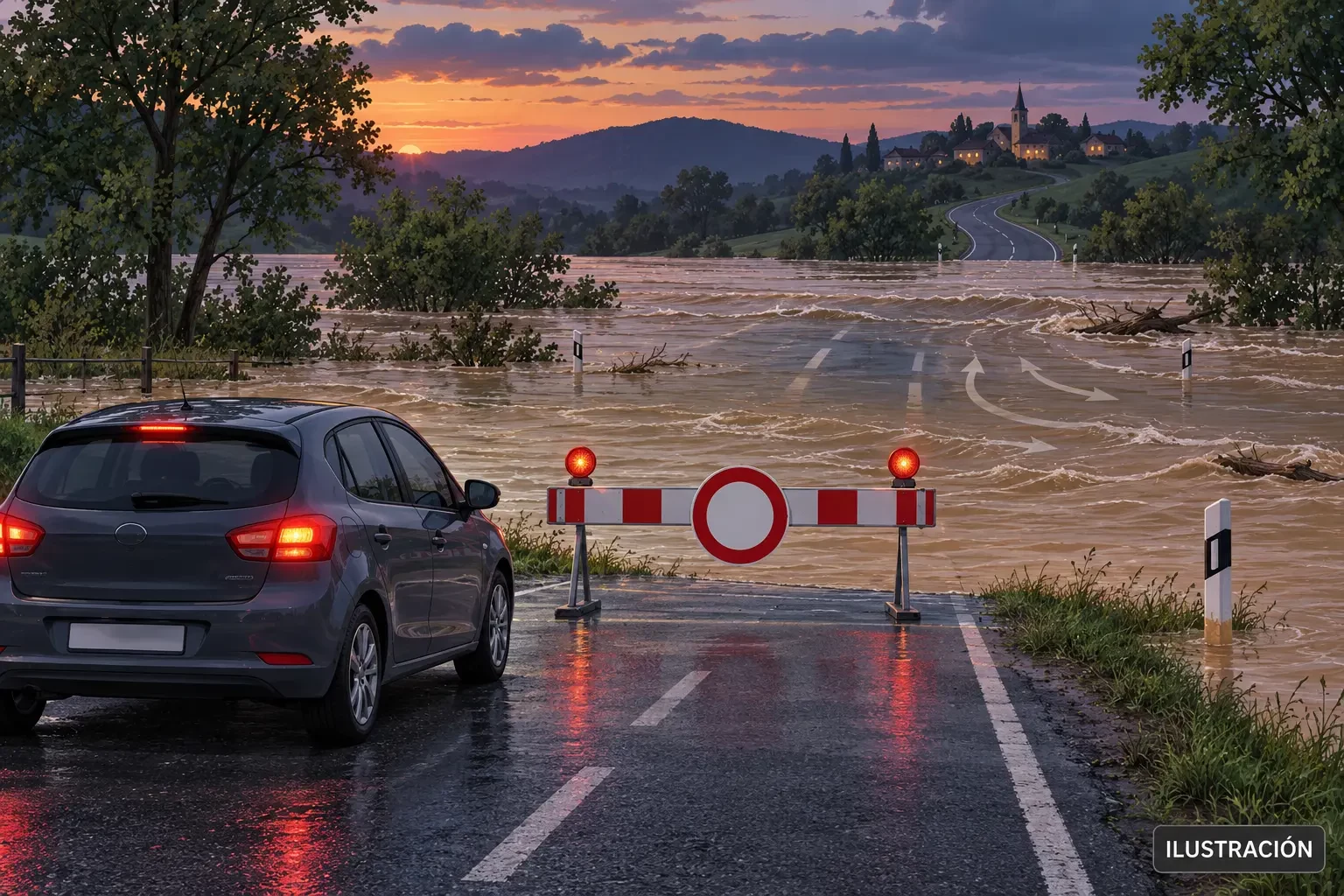
A road covered by water may look passable, especially when you know the route or have just seen another vehicle cross. That impression is deceptive. From the driver's seat you cannot reliably judge the depth, speed of the current or condition of the road. Muddy water may conceal a washout, an open drain, debris or a missing road edge.
The safe decision is simple: do not enter, turn around and find another route. This guide is educational and does not replace current warnings or instructions from emergency services, police, road authorities or civil protection.
Why shallow-looking water can be dangerous
Risk is not determined by depth alone. Current speed and direction, vehicle weight and shape, slope, grip, debris and road damage all matter. There is therefore no depth that can be declared safe for every car and situation.
- Loss of grip: water reduces effective tyre contact and may push the vehicle off line.
- Engine failure: water reaching the air intake can stop the engine and strand the car while levels continue to rise.
- Side force and flotation: comparatively shallow flowing water may move a vehicle, particularly when it strikes the side.
- Hidden damage: a road that looks intact may have been washed away below the surface.
The US National Weather Service uses illustrative figures to communicate the force of water: around 30 centimetres of moving water can float many vehicles, while roughly 60 centimetres can carry most away. These are not safety thresholds and should never encourage visual guesswork. Conditions differ, and depth is difficult to estimate from inside a car.
Before travelling when heavy rain is forecast
- Check the national weather service, civil-protection notices and live road information.
- Avoid non-essential travel when authorities advise it.
- Plan an alternative route away from rivers, dry channels, underpasses and low ground.
- Charge your phone and tell someone your planned route when travelling through an exposed area.
- Do not park in dry riverbeds, ravines, near riverbanks or where water may collect.
A weather warning indicates that hazardous weather is possible or occurring; it cannot identify every street that will flood. A rise may also arrive from upstream after rain has stopped locally. To understand forecast quantities, read our guide to rainfall in millimetres and accumulated totals.
What to do when water covers the road
- Stop before entering. Keep enough distance to manoeuvre without approaching the flooded edge.
- Never pass barriers or closure signs. They block access to a section whose condition may be unknown even to local drivers.
- Turn around. Do not follow another vehicle or treat its successful crossing as proof of safety.
- Use an alternative route or wait somewhere safe. A delay is better than becoming trapped.
- Call the local emergency number if people are in danger, a road has just flooded or damage is not yet marked. Report the location without approaching the water.
If water begins to surround the vehicle
Conditions can change in seconds and there is no single rule for every scene. Call emergency services, share your exact location and follow their instructions. If you can leave and reach higher ground without stepping into moving water, do so early; if getting out requires entering a current, that may be more dangerous. Never try to save the car or retrieve possessions.
If doors cannot open because of pressure or water is entering, prioritise people and use a window if possible. Assist children and dependent passengers first while avoiding unnecessary separation. Once outside, move away from the channel, bridges, walls, slopes and electrical lines.
Common mistakes
- Assuming an SUV, van or heavy vehicle cannot be swept away.
- Relying on local knowledge when the road may have changed within minutes.
- Entering slowly “to test it” and discovering there is no room to turn.
- Walking into the water to measure its depth.
- Returning for the vehicle while levels are still rising.
After the flooding
Do not return until authorities reopen the road. A visible fall in water level does not prove that the surface is stable. If a vehicle has been soaked or partly submerged, do not start it; arrange recovery and mechanical and electrical inspection. Photograph damage only from a safe location.