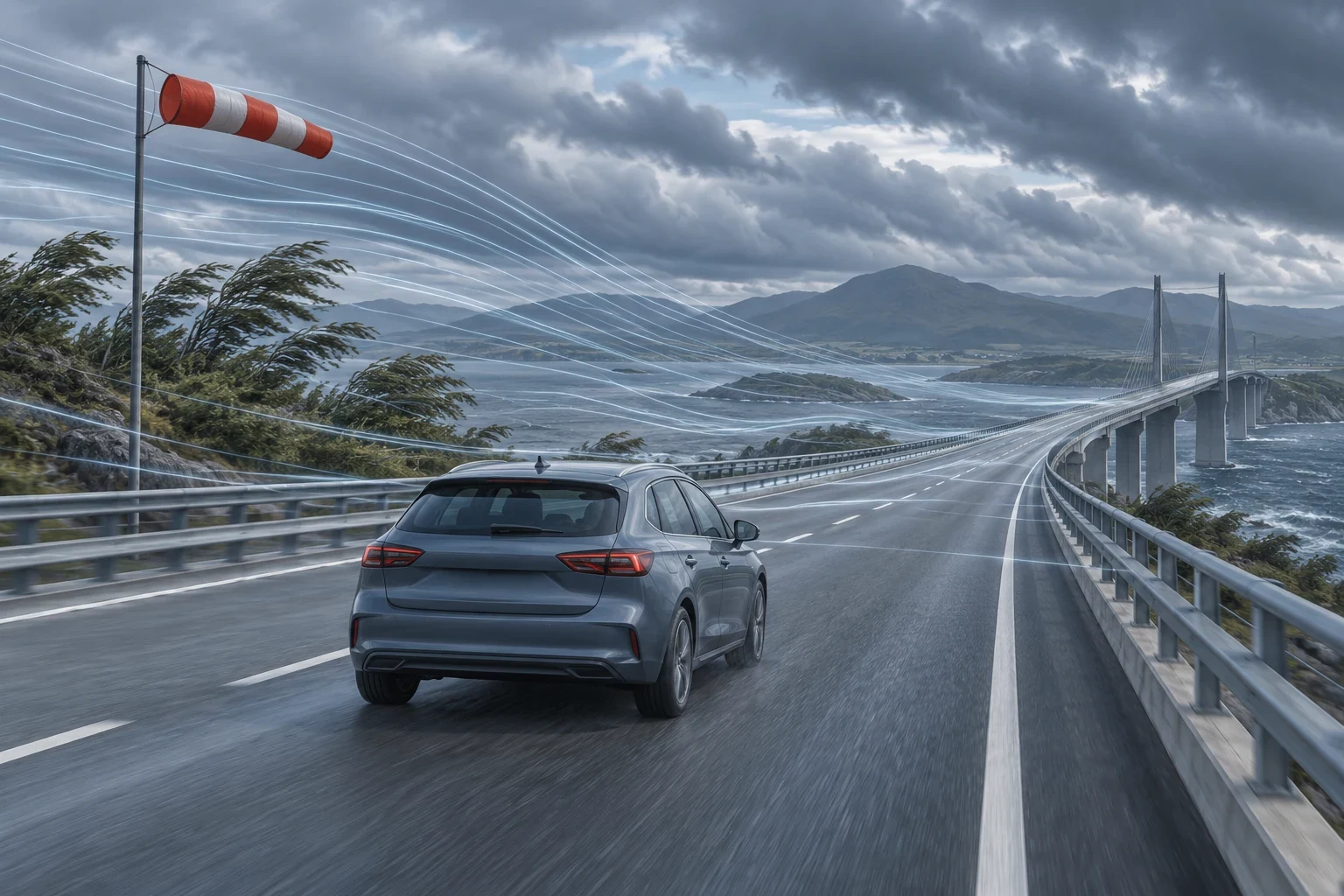
A crosswind does not push with constant force. A sudden gust may move a vehicle sideways just as it leaves a tunnel, crosses a viaduct or completes an overtake. Anticipating these transitions is safer than correcting late with a sharp movement.
This educational guide is not a current warning. Before travelling, check AEMET weather warnings for Spain, road conditions and traffic instructions. Follow any restriction issued by the authorities.
Why a crosswind gust can destabilise a vehicle
The effect depends on wind speed, its angle to the road, vehicle speed and the area exposed to the airflow. Vans, motorhomes, vehicles towing trailers, motorcycles and cars with roof loads are often more sensitive. A fluctuating wind also demands more adjustment than a steady one.
There is no universal wind-speed threshold that guarantees safety for every vehicle and location. An open bridge, elevated road or gap between buildings may be far more exposed than a sheltered section. Our guide to mean wind and gusts explains why the two figures must be read separately.
Where to expect sudden changes
- Tunnel and cutting exits: the vehicle moves from shelter into exposed air.
- Bridges, viaducts and ridges: fewer obstacles slow the flow.
- Passing lorries: the large vehicle temporarily screens the wind, which returns as you clear it.
- Gaps in walls, buildings or trees: shelter and exposure alternate within metres.
- Open land and coasts: windsocks, flags, trees and drifting spray can reveal wind direction.
How to respond before and during a gust
- Reduce speed progressively before the exposed section. Higher speed leaves less room for correction.
- Hold the wheel with both hands, firmly but without locking your arms. Look well ahead to monitor your path.
- Increase following and side clearance. Do not remain close to lorries, cyclists or motorcyclists.
- Use small, smooth steering inputs. Avoid combining a sharp turn with hard braking unless an emergency demands it.
- Avoid unnecessary overtaking. If you pass a lorry, anticipate both its temporary shelter and the renewed crosswind beyond it.
Spain’s Directorate-General for Traffic advises drivers to slow down, keep a firm hold on the steering wheel and take particular care when overtaking large vehicles or leaving tunnels.
If you cannot hold your line
Ease off the accelerator progressively, avoid violent inputs and find a safe, permitted place away from moving traffic. Do not stop on a bridge, inside a tunnel or on a narrow shoulder except in an emergency. Postpone the journey if conditions exceed your ability or the vehicle’s limits.
Before continuing, check that external loads and trailers are properly secured. A sound decision combines the official warning, route exposure, vehicle type and the control you can actually maintain.
Frequently asked questions
Should I steer into the wind?
A slight correction may be needed to remain in lane, but it must be gradual. Wind force changes at the edge of sheltered areas, so excessive correction can send the vehicle towards the opposite side.
Why is overtaking a lorry different?
Its body can temporarily block the wind. Expect two transitions: reduced pressure while alongside it and the return of the gust as you move beyond its wind shadow.
Official sources checked on 15 September 2026: AEMET and Spain’s Directorate-General for Traffic. Cover: AI-generated illustration; it does not depict a real event or location. Official links are in Spanish.