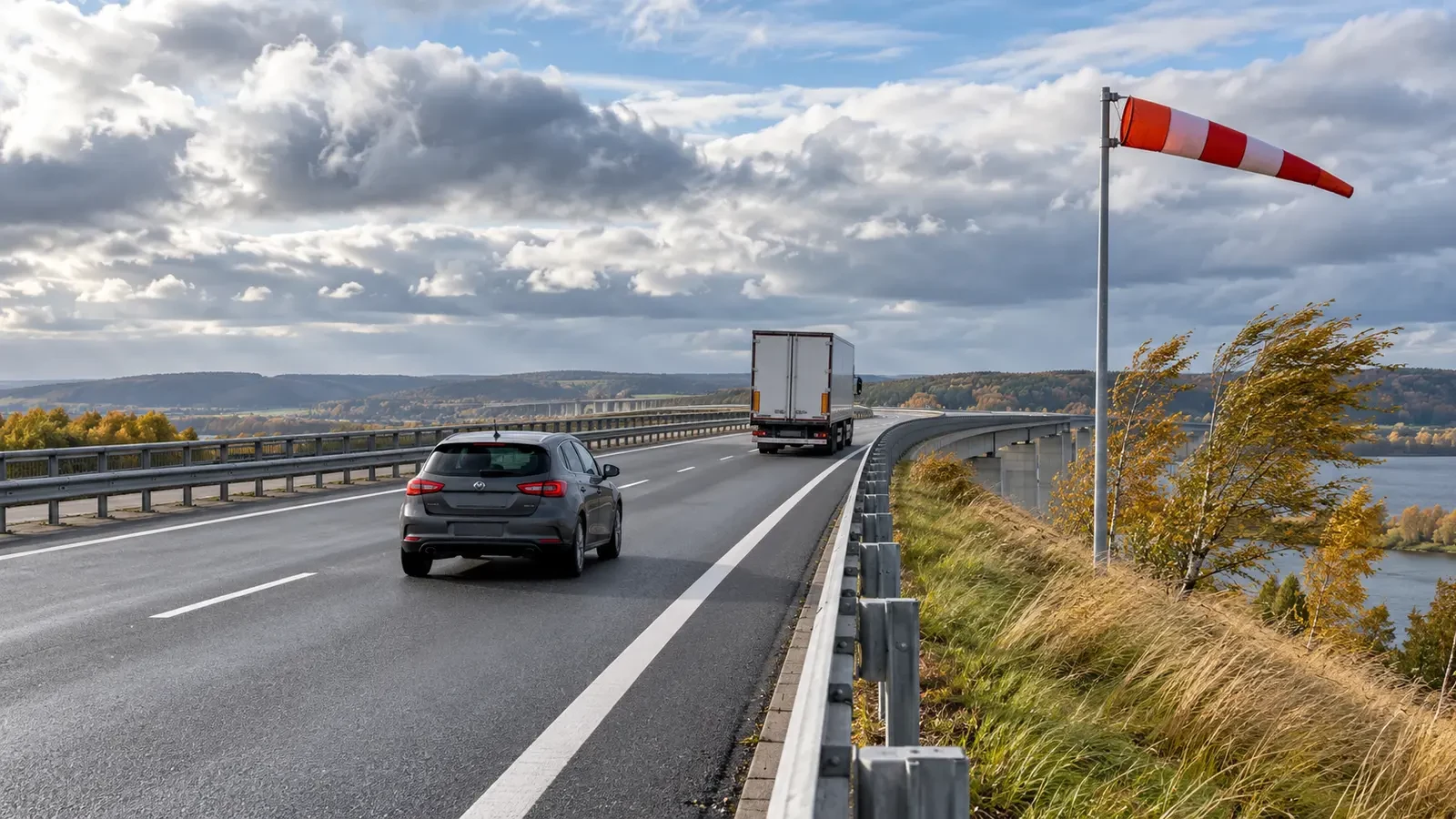
Crosswinds can move a vehicle sideways even when the road is dry and visibility is good. The risk rises when the wind is gusty or returns suddenly after a sheltered section. A full loss of control is not required for danger to develop: one late correction, sharp steering input or narrow lateral gap can move a vehicle towards another lane or the verge.
What a crosswind is
A crosswind is the part of the wind blowing across the direction of travel. Steady wind creates relatively constant pressure; a gust produces a rapid increase that demands a correction. Forecasts distinguish average wind from gusts, but the force reaching the vehicle also depends on terrain, buildings, vegetation and the road’s orientation.
Where sudden changes are most likely
Bridges, viaducts, open roads, mountain gaps, breaks in hedges and buildings, and tunnel exits deserve particular attention. A sheltered cutting or tunnel may make the wind seem weaker. As that protection ends, the lateral force can return immediately. Windsocks, bending trees and the movements of vehicles ahead provide useful warning.
The shielding effect when passing a lorry
A lorry, coach or large van temporarily blocks part of the wind. As a car draws alongside, it may move towards the larger vehicle because the previous side pressure disappears. Once past, the crosswind suddenly returns and pushes the other way. Anticipate both transitions, leave generous space and use small steering corrections rather than a sharp turn.
Adjusting your driving
- Reduce speed progressively and create more time to react.
- Keep both hands on the wheel, firm but not tense.
- Increase following and lateral distance.
- Avoid abrupt acceleration, braking and lane changes.
- Watch windsocks, trees and vehicles further ahead.
- If you cannot reliably remain in lane, stop in a suitable safe place and wait for conditions to improve.
Lower speed reduces the distance travelled during a gust and provides more time to correct. There is no single safe speed for every situation: vehicle type, load, rain, road layout and actual wind strength all matter.
Vehicles most exposed
High-sided vans, caravans, trailers, motorcycles and lorries are particularly vulnerable because of their shape, side area or balance. Roof boxes, bicycles and external loads can also change a vehicle’s response. Check all fastenings before travelling. A light trailer may begin to sway and requires even more space and smoother inputs.
During a strong gust
Look well ahead, maintain your lane and compensate with small, progressive movements. Easing off the accelerator can reduce speed smoothly; harsh braking or sudden steering may make the vehicle less stable. Expect an immediate change when meeting a large vehicle or leaving a tunnel, cutting or line of buildings.
When not to continue
Official warnings, restrictions for high-sided vehicles, flying debris, falling branches or repeated difficulty holding the lane are reasons to reconsider the journey. Check weather warnings and road information. If stopping, choose a place away from trees, signs, poles and exposed structures.
Before setting off
Check tyres, pressures, wipers, the load and anything mounted outside. When warnings are active, consider a route that avoids exposed crossings. Spain’s DGT describes the hazards of side winds, while the UK Highway Code highlights the risk to high-sided vehicles and vulnerable road users.
The aim is not to fight the wind. Anticipate where it will change, preserve space and keep every input smooth.