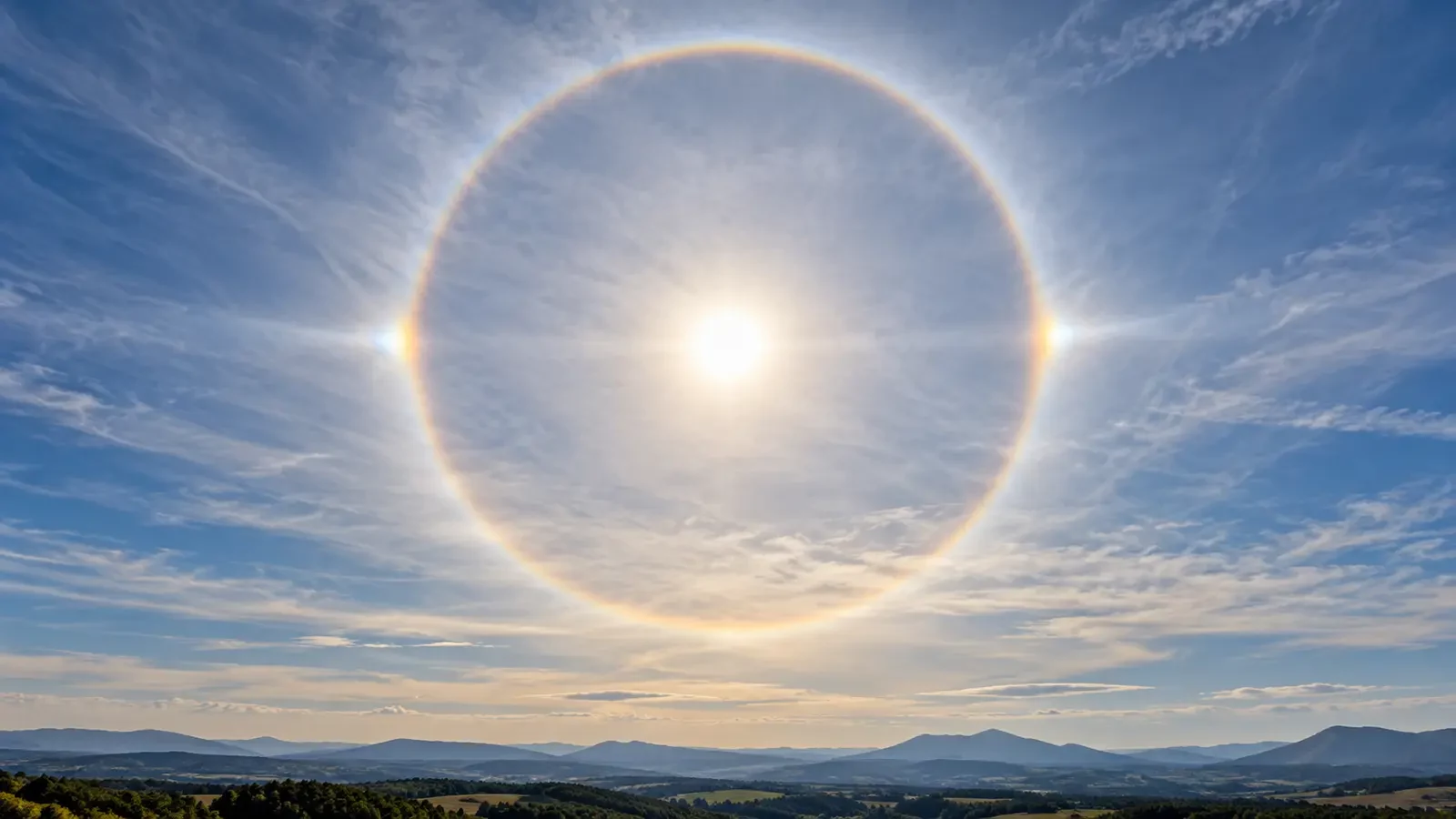
A broad ring around the Sun or Moon can look mysterious, but it is usually an atmospheric optical display called a halo. It forms when light is refracted or reflected by tiny ice crystals suspended in high cloud. The commonest example is the 22-degree halo, a large circle centred on the light source.
Why the ring has a 22-degree radius
Cirrus and especially sheets of cirrostratus contain large numbers of ice crystals. Many are hexagonal. When light enters and leaves particular crystal faces, it changes direction; countless crystals in different orientations send rays towards the observer with a minimum deviation close to 22°. This creates a relatively sharp inner edge, while the area between the Sun or Moon and the ring often looks darker.
The halo is not a fixed object sitting in one part of the cloud. Its geometry depends on the observer, so someone several kilometres away sees a halo produced by a different set of crystals.
How to identify it safely
A 22° halo is much larger than the small glow sometimes seen close to the Sun or Moon. As a rough guide, an outstretched hand at arm’s length spans about twenty degrees. When looking for a solar halo, block the solar disc completely with a building, sign or your hand and never stare at the Sun. Sunglasses do not make direct solar viewing safe.
Sundogs: bright companions to the Sun
Sundogs, or parhelia, are bright patches to the left, right or both sides of the Sun at roughly the same elevation. They also result from refraction through ice crystals, but normally require plate-shaped crystals to be more consistently aligned. They often occur with a 22° halo and may show a reddish edge on the side nearest the Sun.
Lunar halos and colour
The Moon creates the same geometry, although moonlight is far weaker. A lunar halo therefore often looks white to the human eye, while a camera may record subtle colours. A reasonably bright Moon and a thin, not overly opaque, layer of high cloud are needed.
A halo is not a corona
A corona is smaller, lies close to the Sun or Moon and can contain several coloured rings. It is produced mainly by diffraction around similarly sized water droplets — or very small particles. A halo is much wider and is linked to refraction or reflection by ice crystals.
Does a halo mean rain is coming?
Cirrostratus can spread ahead of a weather front, so a halo sometimes precedes a change. It is not a forecast on its own: high cloud can pass without measurable precipitation at your location. Check the official forecast and warnings, and look for broader trends such as thickening cloud, a lowering cloud base or a wind shift.
What it genuinely tells you
- Ice crystals are present in a high atmospheric layer.
- A thin cirrostratus veil may be present even if it is hard to see.
- Different arcs and bright spots reflect crystal shape and orientation.
- The display cannot determine when, where or how much rain will fall.
The Met Office outlines these optical effects, while the US National Weather Service explains the 22° halo and why its link with precipitation is not guaranteed. A halo is an atmospheric clue, not a promise.