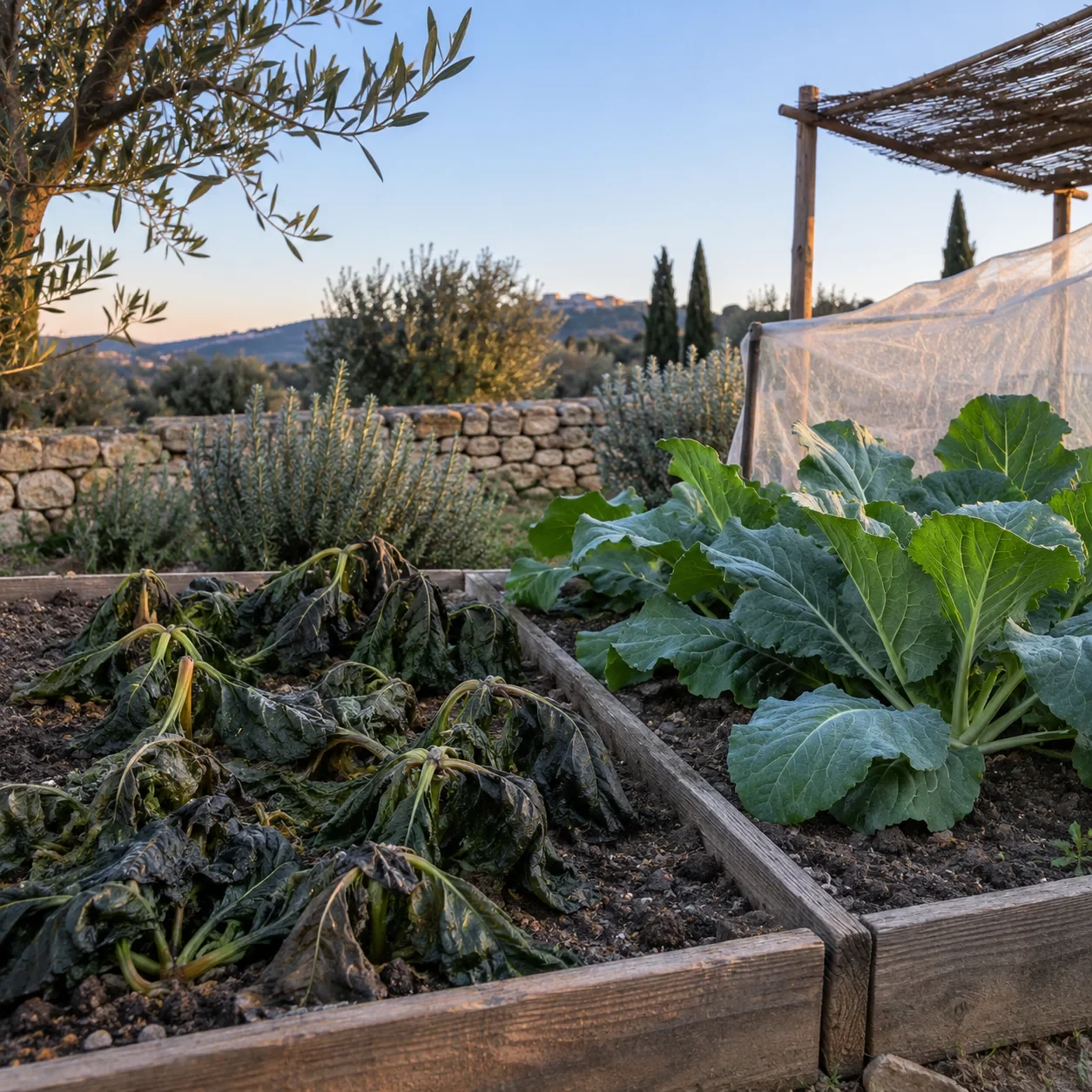
You walk into the garden after a cold night and find dark, limp leaves. There are no white crystals on the soil or foliage. Could frost still be involved? Yes. Gardeners often use the expression black frost when cold damages plants without leaving an obvious white frost deposit. The word black refers to the appearance of injured vegetation; it is not a special kind of black ice or a separate public warning level.
Why white crystals may be absent
Visible hoar frost is ice deposited on a cold surface from water vapour in the surrounding air. A sufficiently cold surface alone does not guarantee a noticeable coating: moisture must also be available near it. During a cold, dry night there may be too little vapour to leave much visible ice. Plant tissues can nonetheless become cold enough to suffer injury. An explanation published by Spain's meteorological agency, AEMET, contrasts external frost crystals with cold injury to plant tissue in drier conditions. Seeing no white frost therefore does not prove the crop was unharmed.
The temperature on a forecast is not necessarily the temperature of every leaf. Forecasts describe an area and a period; station observations describe a specific measuring site. Leaves exposed to the night sky, plants near the ground and plants beneath a cover can cool differently. Wind, cloud, local slopes and shelter can change the balance further. Even a good thermometer is useful only if you record where and how it was placed.
Compare places before deciding on a cause
Picture two beds planted with the same variety and watered in much the same way. One lies in a low, open part of the garden; the other is slightly higher and partly sheltered. By morning the first has drooping, dark leaves while the second looks normal. Neither has white crystals. This is a hypothetical example, not a report of an actual frost event. The differing exposure makes overnight cooling a plausible explanation, but it cannot establish the cause on its own. Previous water stress, disease, wind damage or differences in plant age might also matter.
Consider the reverse comparison as well. On a humid night both beds might show a white coating, while only one later shows obvious injury. An external ice deposit and internal tissue damage are related observations, not interchangeable diagnoses. Plant species, growth stage, how long the cold lasted and the subsequent warming all affect the outcome. A photograph taken at sunrise cannot tell you the entire sequence.
A practical observation checklist
Start by recording the date, location, forecast minimum and any nearby measured temperature. Label a forecast as a forecast, rather than treating it as a reading from your plot. Note whether the sky was clear, whether there was wind and which beds had cover. Compare plants of the same type in exposed and protected spots. Photograph them at first light and check them again after the day has warmed; a single drooping leaf is not enough to diagnose permanent damage.
If you take measurements near the crop, record the height and position of the thermometer so later readings are comparable. Then test other explanations: were the beds watered differently, were any leaves damaged before the cold night, and is there a pattern linked to shade or disease? These notes can help identify where additional protection deserves a trial. They cannot guarantee that a particular cover will save every species in every episode. For valuable crops, seek locally appropriate horticultural advice and follow official weather warnings.
The cover image is an illustration of a possible comparison, not a photograph of a documented event. AEMET offers a useful explanation of dew and external frost crystals.